O Levels/IGCSE Chemistry (5070)•5070/11/O/N/21
O Levels/IGCSE Chemistry (5070) — 5070/11/O/N/21, Question 18
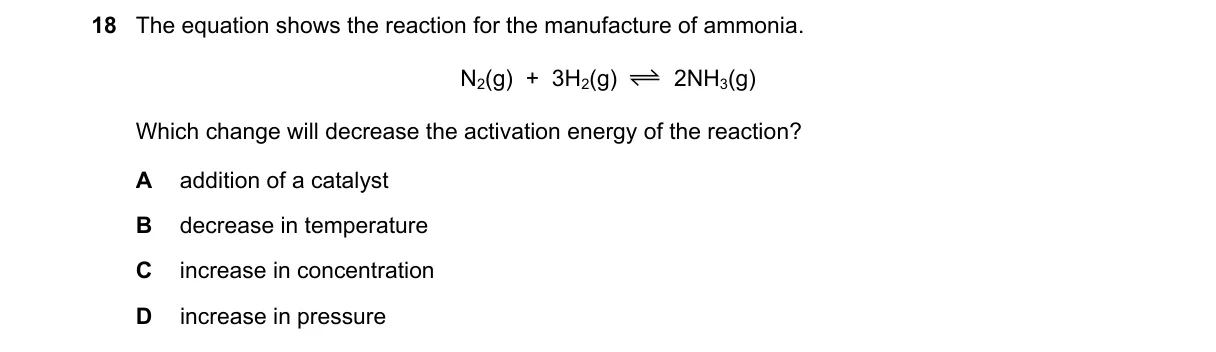
The equation shows the reaction for the manufacture of ammonia. N₂(g) + 3H₂(g) ⇌ 2NH₃(g). Which change will decrease the activation energy of the reaction?
Answer choices
- Aaddition of a catalyst
- Bdecrease temperature
- Cincrease in concentration
- Dincrease in pressure
Explanation
Catalysts lower activation energy in reactions
Steps:
- Activation energy (Ea) is the energy barrier reactants must overcome to form products.
- Catalysts speed up reactions by offering an alternative pathway with reduced Ea.
- Temperature, concentration, and pressure influence reaction rate via collision theory but do not alter Ea.
- For the ammonia synthesis, only a catalyst directly lowers Ea.
Why A is correct:
- A catalyst decreases activation energy by providing a lower-energy reaction pathway, as defined in chemical kinetics (Arrhenius equation: rate constant k = A e^(-Ea/RT)).
Why the others are wrong:
- B: Decreasing temperature reduces molecular kinetic energy, slowing the rate but leaving Ea unchanged.
- C: Increasing concentration raises collision frequency, boosting rate without affecting Ea.
- D: Increasing pressure compresses gases, effectively raising concentration and rate, but Ea remains the same.
Final answer: A
Topic: Rate of reaction
Practice more O Levels/IGCSE Chemistry (5070) questions on mMCQ.me