O Levels/IGCSE Chemistry (5070)•5070/11/O/N/21
O Levels/IGCSE Chemistry (5070) — 5070/11/O/N/21, Question 1
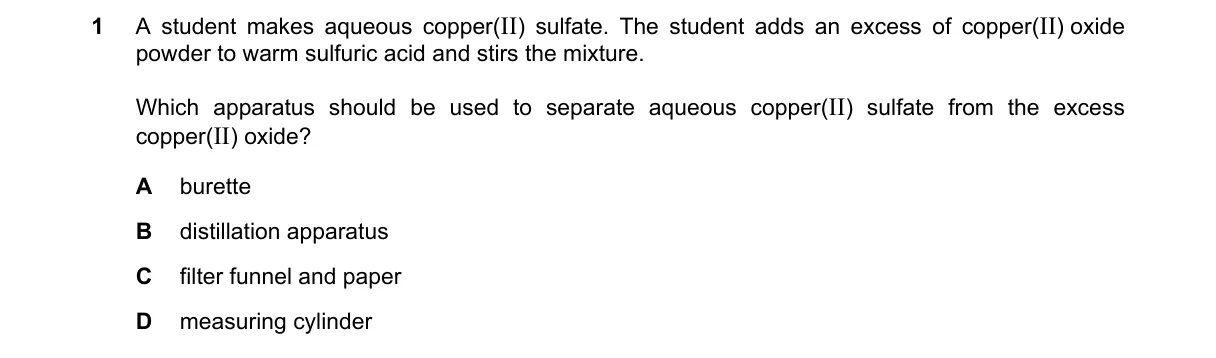
A student makes aqueous copper(II) sulfate. The student adds excess copper(II) oxide powder to warm sulfuric acid and stirs the mixture. Which apparatus should be used to separate aqueous copper(II) sulfate from the excess copper(II) oxide?
Answer choices
- Aburette
- Bdistillation apparatus
- Cfilter funnel and paper
- Dmeasuring cylinder
Explanation
Separating insoluble solid from solution
Steps:
- Identify the mixture as excess solid copper(II) oxide in aqueous copper(II) sulfate solution.
- Select filtration to separate the insoluble solid from the liquid.
- Use filter funnel and paper to trap the solid while allowing the solution to pass through.
- Collect the filtrate as the separated aqueous copper(II) sulfate.
Why C is correct:
- Filtration separates insoluble solids from liquids by passing the mixture through porous filter paper, which retains the solid particles (basic principle of heterogeneous mixture separation).
Why the others are wrong:
- A: Burette dispenses precise volumes of liquid, not for separating solids.
- B: Distillation separates liquids by boiling point differences, unsuitable for solid-liquid mixtures.
- D: Measuring cylinder measures liquid volumes, not for separation.
Final answer: C
Topic: Separation and purification
Practice more O Levels/IGCSE Chemistry (5070) questions on mMCQ.me