O Levels/IGCSE Chemistry (5070)•5070/12/O/N/20
O Levels/IGCSE Chemistry (5070) — 5070/12/O/N/20, Question 5
Aqueous zinc chloride is tested with various reagents. Which observation is correct?
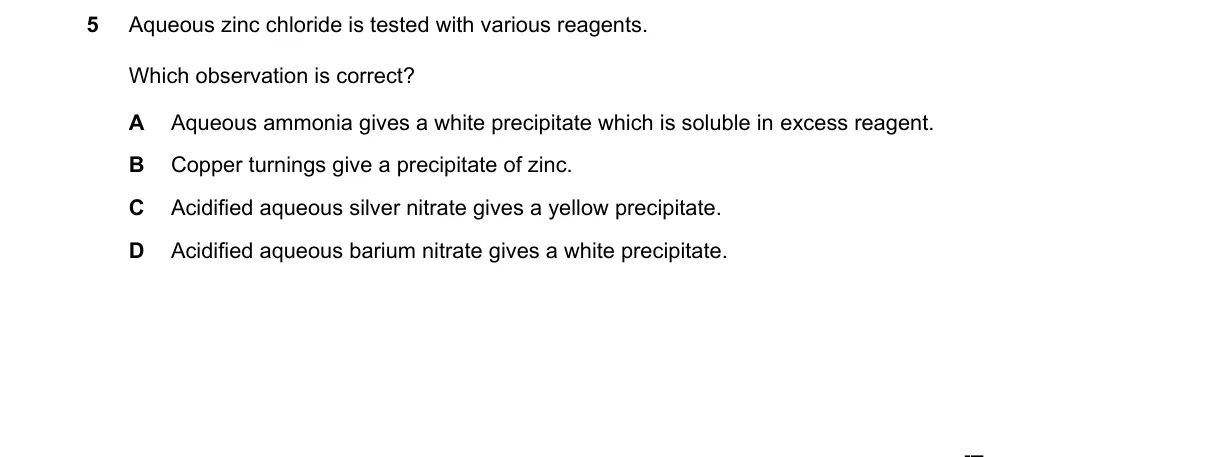
Answer choices
- AAqueous ammonia gives a white precipitate which is soluble in excess reagent.
- BCopper turnings give a precipitate of zinc which turns into ammonia.
- CAcidified aqueous silver nitrate gives a yellow precipitate.
- DAcidified aqueous barium nitrate gives a white precipitate.
Explanation
Zinc ion precipitation and solubility tests
Steps:
- Identify Zn²⁺ from ZnCl₂ reacts with NH₃ to form white Zn(OH)₂ precipitate.
- Note excess NH₃ dissolves it as [Zn(NH₃)₄]²⁺ complex.
- Evaluate B: Cu turnings with ZnCl₂ yield no reaction, as Zn is more reactive but no displacement occurs without Cu²⁺.
- Evaluate C and D: Test for halide or anion precipitates, irrelevant to Zn²⁺.
Why A is correct:
- Zn²⁺ + 2NH₃ + 2H₂O → Zn(OH)₂ (white ppt) + 2NH₄⁺; excess NH₃ forms soluble [Zn(NH₃)₄]²⁺ per coordination chemistry.
Why the others are wrong:
- B: No zinc precipitate forms; Cu cannot reduce Zn²⁺, and ammonia is absent.
- C: AgNO₃ with Cl⁻ gives white AgCl, not yellow (yellow for Br⁻/I⁻).
- D: Ba(NO₃)₂ tests for SO₄²⁻; no white BaCl₂ precipitate forms.
Final answer: A
Topic: Identification of ions and gases
Practice more O Levels/IGCSE Chemistry (5070) questions on mMCQ.me