O Levels/IGCSE Chemistry (5070)•5070/12/O/N/20
O Levels/IGCSE Chemistry (5070) — 5070/12/O/N/20, Question 33
Four processes used during purification of water: use of carbon, desalination, chlorination, filtration. The purposes W, X, Y and Z for these processes are listed. W: disinfection, X: remove solids, Y: removal of tastes and odors. What is the purpose for each process?
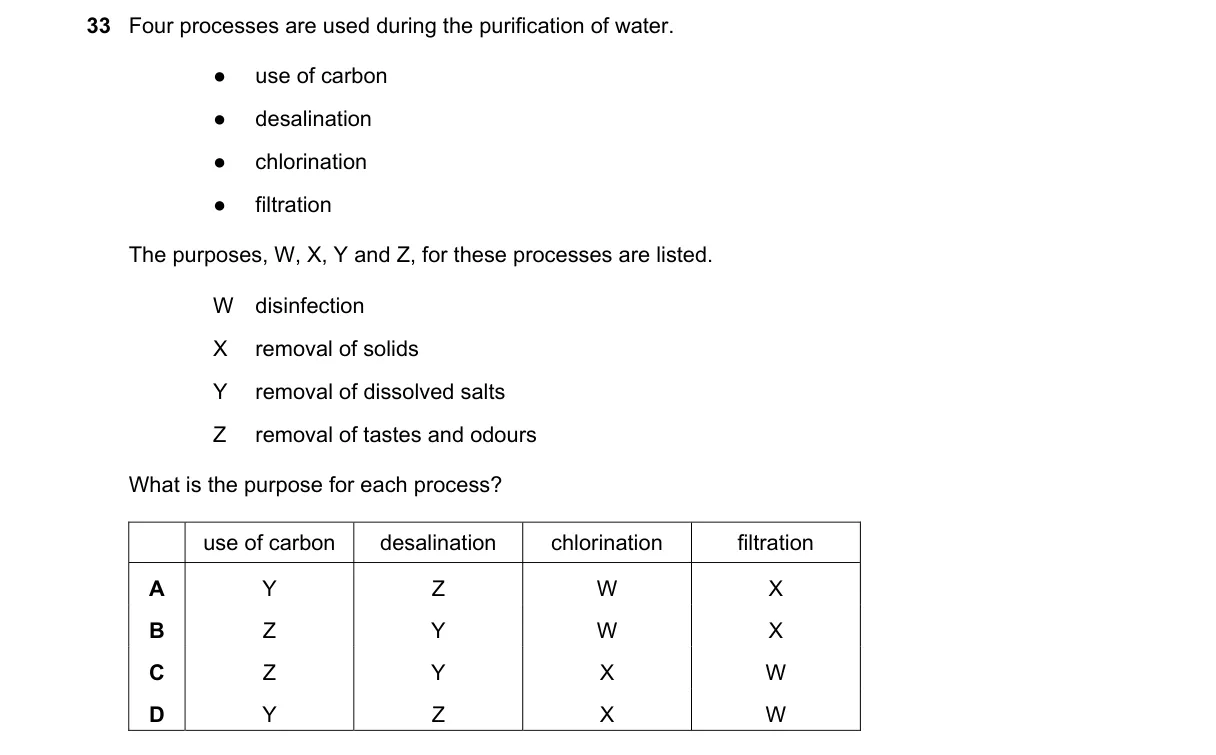
Answer choices
- Ause of carbon Y, desalination Z, chlorination W, filtration X
- Buse of carbon Z, desalination Y, chlorination W, filtration X
- Cuse of carbon Y, desalination Z, chlorination X, filtration W
- Duse of carbon Y, desalination Z, chlorination X, filtration W
Explanation
Matching water purification processes to purposes Steps:
- Recall filtration physically traps suspended particles, matching X: remove solids.
- Recall chlorination adds chlorine to kill pathogens, matching W: disinfection.
- Recall activated carbon adsorbs organic impurities, matching Y: removal of tastes and odors.
- Recall desalination removes dissolved salts via methods like reverse osmosis, matching Z: removal of salts.
Why A is correct:
- Activated carbon targets organic compounds for taste and odor removal (Y), while desalination eliminates salts (Z), aligning with standard purification definitions.
Why the others are wrong:
- B: Desalination assigned to Y (tastes/odors), but it primarily removes salts, not organics.
- C: Chlorination assigned to X (remove solids), but it disinfects chemically, not by filtration.
- D: Filtration assigned to W (disinfection), but it removes solids physically, not pathogens.
Final answer: A
Topic: Water
Practice more O Levels/IGCSE Chemistry (5070) questions on mMCQ.me