O Levels/IGCSE Chemistry (5070)•5070/11/O/N/20
O Levels/IGCSE Chemistry (5070) — 5070/11/O/N/20, Question 5
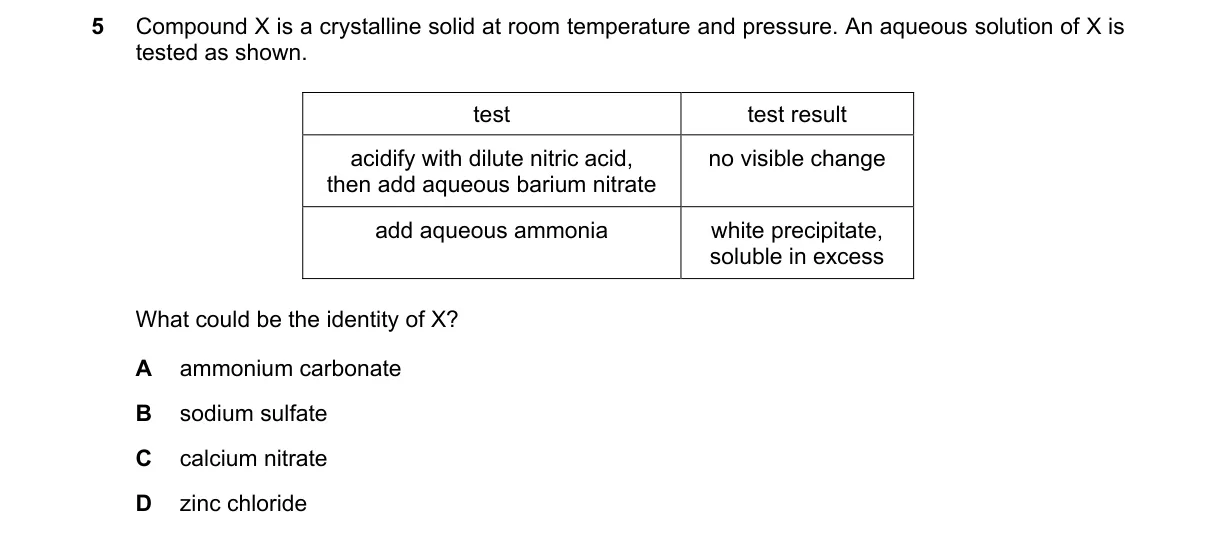
Compound X is a crystalline solid at room temperature and pressure. An aqueous solution of X is tested as shown. Acidify with dilute nitric acid then add aqueous barium nitrate: no visible change. Add aqueous ammonia: white precipitate, soluble in excess. What could be the identity of X?
Answer choices
- Asodium carbonate
- BOption B
- Ccalcium nitrate
- Dzinc chloride
Explanation
Identification via barium and ammonia solubility tests
Steps:
- Acidification with nitric acid followed by barium nitrate yields no precipitate, ruling out sulfate ions (BaSO4 would form white ppt).
- No visible change confirms absence of other anions like sulfate that precipitate with Ba2+ post-acidification.
- Adding aqueous ammonia produces a white precipitate soluble in excess, characteristic of Zn2+ forming Zn(OH)2 then dissolving as [Zn(NH3)4]2+.
- Thus, X contains Zn2+ and no interfering anions, matching zinc chloride.
Why D is correct:
- ZnCl2 dissociates to Zn2+ and Cl-; Zn2+ gives white Zn(OH)2 ppt with NH3, soluble in excess due to amphoteric nature and complex formation.
Why the others are wrong:
- A. Sodium carbonate: No precipitate with ammonia, as no metal cation forms hydroxide.
- C. Calcium nitrate: Forms white Ca(OH)2 ppt with ammonia, but insoluble in excess (Ca2+ not amphoteric).
Final answer: D
Topic: Identification of ions and gases
Practice more O Levels/IGCSE Chemistry (5070) questions on mMCQ.me