O Levels/IGCSE Chemistry (5070)•5070/11/O/N/20
O Levels/IGCSE Chemistry (5070) — 5070/11/O/N/20, Question 25
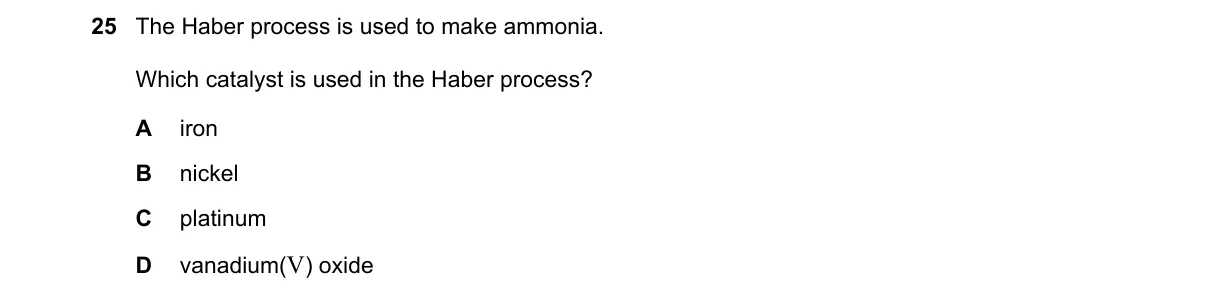
The Haber process is used to make ammonia. Which catalyst is used in the Haber process?
Answer choices
- Airon
- Bnickel
- Cplatinum
- Dvanadium(V)oxide
Explanation
Catalyst for Ammonia Synthesis in Haber Process
Steps:
- Recall the Haber process synthesizes ammonia from nitrogen and hydrogen under high pressure and temperature.
- Identify that a catalyst speeds up the reaction by lowering activation energy without being consumed.
- Remember the industrial catalyst must be effective for N2 + 3H2 ⇌ 2NH3 equilibrium.
- Match the catalyst to standard chemical engineering knowledge for this reversible reaction.
Why A is correct:
- Iron, often promoted with potassium oxide and alumina, is the primary catalyst in the Haber-Bosch process, enabling efficient ammonia production at 400–500°C as per industrial standards.
Why the others are wrong:
- B. Nickel: Used in hydrogenation reactions, such as fat hardening, not nitrogen fixation.
- C. Platinum: Employed in the Ostwald process for nitric acid production from ammonia oxidation.
- D. Vanadium(V) oxide: Functions in the contact process for sulfuric acid via SO2 oxidation.
Final answer: A
Topic: Reversible reactions and equilibrium
Practice more O Levels/IGCSE Chemistry (5070) questions on mMCQ.me