O Levels/IGCSE Chemistry (5070)•5070/11/O/N/20
O Levels/IGCSE Chemistry (5070) — 5070/11/O/N/20, Question 24
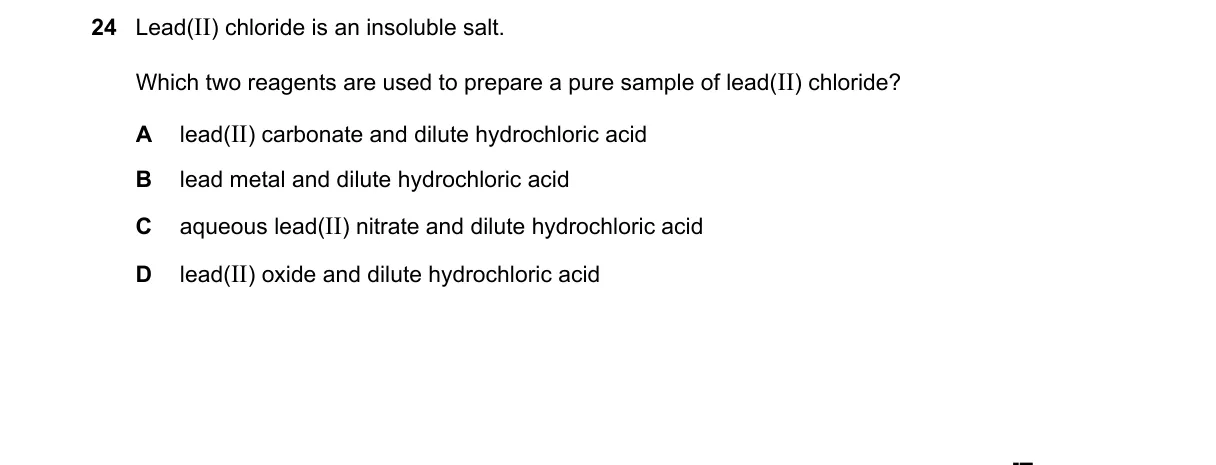
Lead(II) chloride is an insoluble salt. Which reagents are used to prepare a pure sample of lead(II) chloride?
Answer choices
- Alead(II) carbonate and dilute hydrochloric acid
- Baqueous lead(II) nitrate and dilute hydrochloric acid
- Caqueous lead(II) nitrate and hydrochloric acid
- Dlead(II) oxide and dilute hydrochloric acid
Explanation
Precipitation of pure PbCl₂ using soluble reagents
Steps:
- Select aqueous lead(II) nitrate as the source of soluble Pb²⁺ ions.
- Add hydrochloric acid as the source of Cl⁻ ions.
- Mix to form the precipitate: Pb(NO₃)₂(aq) + 2HCl(aq) → PbCl₂(s) + 2HNO₃(aq).
- Filter, wash with distilled water, and dry the solid for a pure sample.
Why C is correct:
- It employs the double displacement reaction between soluble Pb²⁺ and Cl⁻ ions, yielding a pure PbCl₂ precipitate free from soluble impurities, per standard precipitation method for insoluble salts.
Why the others are wrong:
- A: Insoluble PbCO₃ reacts heterogeneously with HCl, risking incomplete reaction and unreacted solid impurities in the product.
- B: Specifies "dilute" HCl, which may limit Cl⁻ concentration and lead to incomplete precipitation compared to standard HCl.
- D: Insoluble PbO causes a heterogeneous acid reaction, potentially trapping oxide impurities in the PbCl₂.
Final answer: C
Topic: Preparation of salts
Practice more O Levels/IGCSE Chemistry (5070) questions on mMCQ.me