O Levels/IGCSE Chemistry (5070)•5070/11/O/N/20
O Levels/IGCSE Chemistry (5070) — 5070/11/O/N/20, Question 19
Concentrated aqueous sodium chloride is electrolysed using inert electrodes. Which row shows what happens in this electrolysis and why it happens?
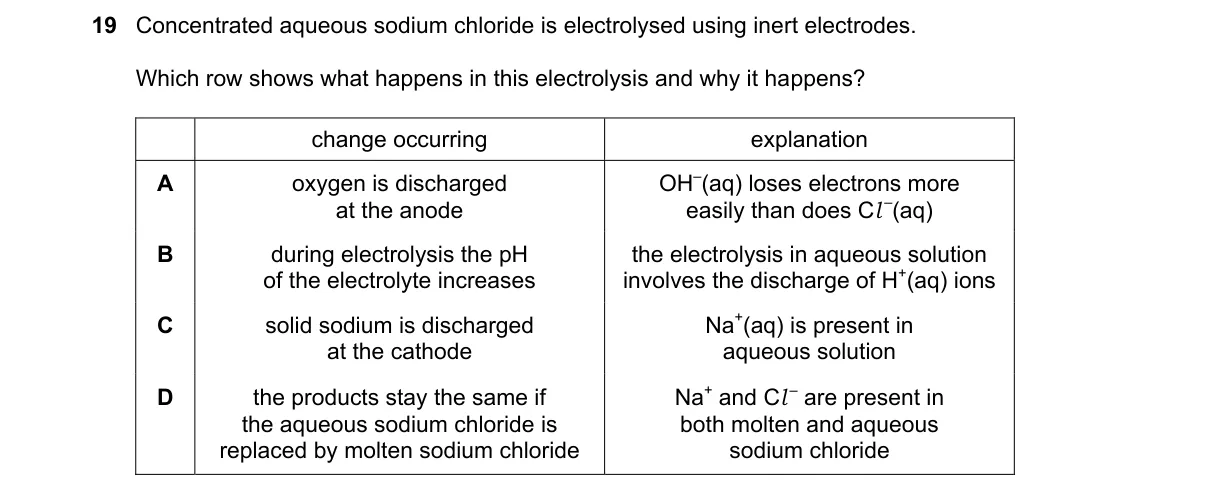
Answer choices
- Aduring electrolysis the pH of the aqueous solution increases because OH-(aq) loses electrons
- Bthe concentration of the aqueous solution decreases because Na+(aq) is present rather than H+(aq)
- Csolid sodium is discharged because the electrolysis of aqueous NaCl(aq) involves discharge of H+(aq)
- Dthe products stay the same if replaced by molten sodium chloride because Na+ and Cl- are present in both molten and aqueous sodium chloride
Explanation
Electrolysis products of concentrated aqueous NaCl Steps:
- Ions present: Na+, Cl-, and H2O (providing H+ and OH-).
- At cathode: Water reduces to H2 and OH- (E° = -0.83 V), not Na+ (E° = -2.71 V), so Na+ remains.
- At anode: Concentrated Cl- oxidizes to Cl2 (overdischarge of OH- to O2).
- Overall: Cl- depletes as Cl2, Na+ pairs with OH- to form NaOH, decreasing NaCl concentration.
Why B is correct:
- Concentration decreases because Na+ is not discharged (water reduces preferentially, per standard electrode potentials), leaving Na+ while Cl- is removed as Cl2.
Why the others are wrong:
- A: pH increases from OH- production at cathode, not OH- losing electrons (which would be oxidation at anode).
- C: No sodium discharged (Na+ not reduced in water); water, not H+, is discharged at cathode.
- D: Molten NaCl yields Na and Cl2; aqueous yields H2, Cl2, NaOH due to water's involvement.
Final answer: B
Topic: Electrolysis
Practice more O Levels/IGCSE Chemistry (5070) questions on mMCQ.me