O Levels/IGCSE Chemistry (5070)•5070/11/O/N/20
O Levels/IGCSE Chemistry (5070) — 5070/11/O/N/20, Question 18
Aqueous copper(II) sulfate is electrolysed using copper electrodes. The current is constant and the anode is weighed at regular time intervals. Which graph is obtained when the mass of the anode is plotted against time?
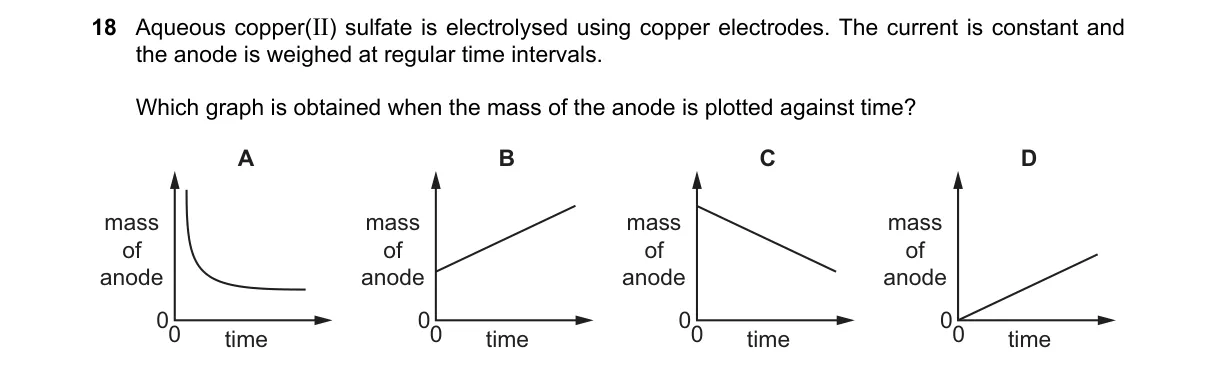
Answer choices
- AOption A
- BOption B
- COption C
- DOption D
Explanation
Anode Dissolves Linearly in CuSO₄ Electrolysis with Cu Electrodes
Steps:
- At the anode, copper oxidizes: Cu(s) → Cu²⁺(aq) + 2e⁻, releasing Cu²⁺ ions into solution.
- Constant current ensures steady electron flow, so oxidation rate remains uniform.
- By Faraday's first law, mass lost equals charge passed divided by electrochemical equivalent, yielding linear mass decrease.
- Plotting anode mass vs. time gives a straight line with negative slope.
Why C is correct:
- C depicts a straight line decreasing over time, matching Faraday's law for constant current and anode dissolution.
Why the others are wrong:
- A: Horizontal line implies no mass change, but anode dissolves.
- B: Increasing line suits cathode deposition, not anode loss.
- D: Curved line suggests varying rate, but current is constant.
Final answer: C
Topic: Electrolysis
Practice more O Levels/IGCSE Chemistry (5070) questions on mMCQ.me