O Levels/IGCSE Chemistry (5070)•5070/12/O/N/19
O Levels/IGCSE Chemistry (5070) — 5070/12/O/N/19, Question 8
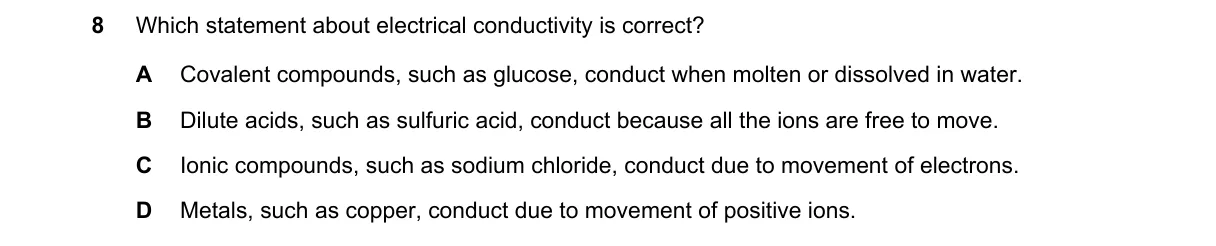
Which statement about electrical conductivity is incorrect?
Answer choices
- ACovalent compounds, such as glucose, conduct when molten or dissolved in water.
- BDilute acids, such as sulfuric acid, conduct because the ions are free to move.
- CIonic compounds, such as sodium chloride, conduct due to movement of electrons.
- DMetals, such as copper, conduct due to movement of positive ions.
Explanation
Identifying the incorrect statement on electrical conductivity mechanisms
Steps:
- Recall that electrical conductivity requires mobile charged particles: ions in electrolytes or electrons in metals.
- Evaluate A: Covalent compounds like glucose lack ions, so they do not conduct in molten or aqueous states.
- Evaluate B: Dilute acids ionize to produce free ions (e.g., H⁺ and SO₄²⁻ in H₂SO₄), enabling conduction.
- Evaluate C: Ionic compounds conduct via ion movement in solution or molten form, not electrons.
- Evaluate D: Metals conduct via delocalized electrons, not ion movement.
Why C is correct:
- Ionic solids like NaCl conduct electricity only when molten or dissolved, due to free-moving ions (Na⁺ and Cl⁻), per the definition of ionic conduction; electrons are fixed in ionic lattices.
Why the others are wrong:
- A is incorrect because glucose is a non-electrolyte with no ions, so it does not conduct.
- B is correct as stated, matching the ionization of acids producing mobile ions.
- D is incorrect because copper's conduction involves free electrons in a "sea" model, not positive ions.
Final answer: C
Topic: Ion and ionic bonds
Practice more O Levels/IGCSE Chemistry (5070) questions on mMCQ.me