O Levels/IGCSE Chemistry (5070)•5070/11/O/N/19
O Levels/IGCSE Chemistry (5070) — 5070/11/O/N/19, Question 18
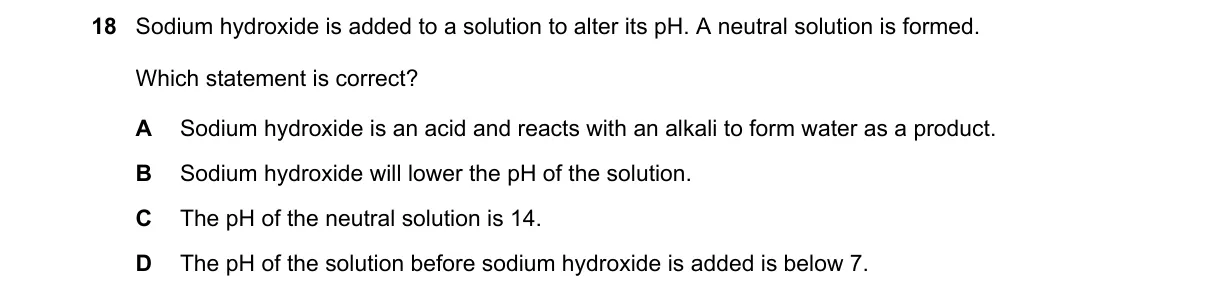
Sodium hydroxide is added to a solution. A neutral solution is formed. Which statement is correct?
Answer choices
- ASodium hydroxide is an acid and reacts with an alkali to form a product.
- BSodium hydroxide lowers the pH of the solution.
- CThe pH of the neutral solution is 14.
- DThe pH of the solution before sodium hydroxide is added is below 7.
Explanation
Neutralization requires an acidic starting solution
Steps:
- Sodium hydroxide (NaOH) is a strong base that increases pH.
- Adding NaOH to a solution produces a neutral solution with pH 7.
- Neutralization happens when a base reacts with an acid to form salt and water.
- Thus, the original solution must be acidic (pH < 7) for NaOH to neutralize it.
Why D is correct:
- By definition, neutralization adjusts an acidic solution (pH < 7) to pH 7 using a base like NaOH.
Why the others are wrong:
- A: NaOH is a base, not an acid; it reacts with acids, not alkalis.
- B: NaOH raises pH as a base, rather than lowering it.
- C: Neutral solution has pH 7, while pH 14 indicates a strong base.
Final answer: D
Topic: The characteristic properties of acids and bases
Practice more O Levels/IGCSE Chemistry (5070) questions on mMCQ.me