O Levels/IGCSE Chemistry (5070)•5070/12/O/N/18
O Levels/IGCSE Chemistry (5070) — 5070/12/O/N/18, Question 38
An ester is formed from a carboxylic acid and an alcohol. How does the number of carbon, hydrogen and oxygen atoms in the ester differ from the total number of these atoms in the carboxylic acid and alcohol from which the ester is formed?
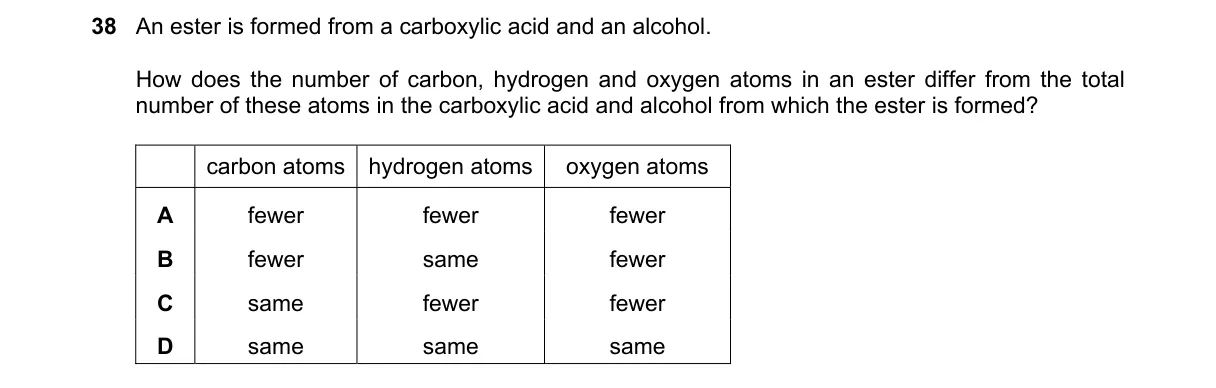
Answer choices
- Afewer carbon atoms, same hydrogen atoms, fewer oxygen atoms
- Bfewer carbon atoms, fewer hydrogen atoms, same oxygen atoms
- Csame carbon atoms, fewer hydrogen atoms, fewer oxygen atoms
- Dsame carbon atoms, same hydrogen atoms, same oxygen atoms
Explanation
Esterification eliminates water Steps:
- Ester forms via RCOOH + R'OH → RCOOR' + H₂O.
- Carbon atoms: All carbons from acid (R + C + OOH) and alcohol (R' + OH) transfer to ester; none lost.
- Hydrogen atoms: Water removes 2H (1 from acid's OH, 1 from alcohol's OH).
- Oxygen atoms: Water removes 1O (from acid's OH).
Why C is correct:
- Esterification reaction (RCOOH + R'OH → RCOOR' + H₂O) conserves all C atoms but subtracts 2H and 1O in H₂O.
Why the others are wrong:
- A: No carbon atoms lost; all preserved in ester.
- B: Oxygen atoms decrease by 1; not the same.
- D: Hydrogen and oxygen atoms decrease; not the same.
Final answer: C
Topic: Carboxylic acids
Practice more O Levels/IGCSE Chemistry (5070) questions on mMCQ.me