O Levels/IGCSE Chemistry (5070)•5070/12/O/N/18
O Levels/IGCSE Chemistry (5070) — 5070/12/O/N/18, Question 33
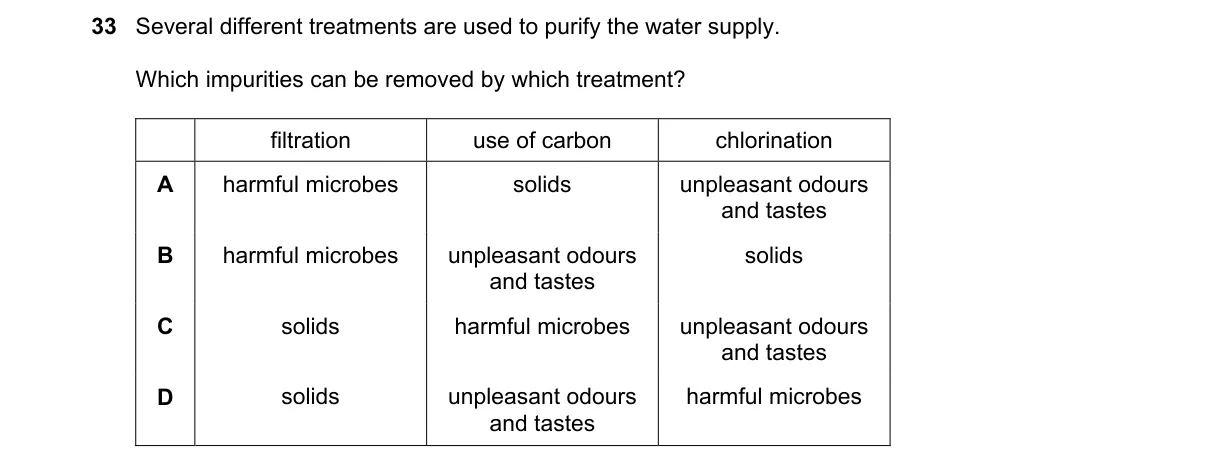
Several different treatments are used to purify the water. Which impurities can be removed by which treatment?
Answer choices
- AFiltration: harmful microbes, Use of carbon: solids, Chlorination: unpleasant odours and tastes
- BFiltration: harmful microbes, Use of carbon: unpleasant odours and tastes, Chlorination: solids
- CFiltration: solids, Use of carbon: harmful microbes, Chlorination: unpleasant odours and tastes
- DFiltration: solids, Use of carbon: unpleasant odours and tastes, Chlorination: harmful microbes
Explanation
Matching purification methods to impurities removed
Steps:
- Identify filtration's role: passes water through barriers to trap suspended solids like dirt and particles.
- Identify activated carbon's role: adsorbs dissolved organic chemicals responsible for unpleasant odors and tastes.
- Identify chlorination's role: adds chlorine gas or compounds to kill harmful microbes like bacteria and viruses.
- Compare roles to options: only D assigns each method correctly.
Why D is correct:
- Filtration physically strains out solids (definition: mechanical separation of particles >0.1 microns), carbon adsorbs odor-causing organics (adsorption law: surface attraction of molecules), and chlorination oxidizes microbial cell walls (disinfection via hypochlorous acid formation).
Why the others are wrong:
- A: Filtration targets solids, not microbes; carbon targets odors, not solids; chlorination targets microbes, not odors.
- B: Filtration targets solids, not microbes; chlorination targets microbes, not solids.
- C: Carbon targets odors, not microbes; chlorination targets microbes, not odors.
Final answer: D
Topic: Water
Practice more O Levels/IGCSE Chemistry (5070) questions on mMCQ.me