O Levels/IGCSE Chemistry (5070)•5070/11/O/N/18
O Levels/IGCSE Chemistry (5070) — 5070/11/O/N/18, Question 7
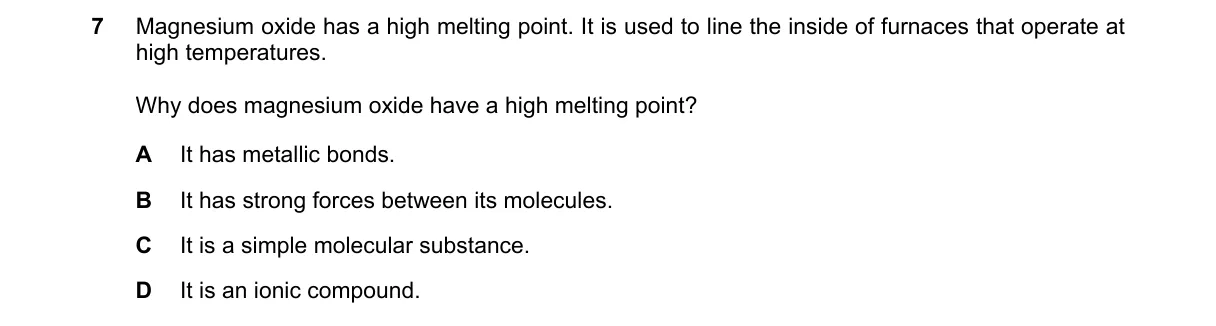
Magnesium oxide has a high melting point. It is used to line the inside of furnaces that operate at high temperatures. Why does magnesium oxide have a high melting point?
Answer choices
- AIt has metallic bonds.
- BIt has strong forces between its molecules.
- CIt is a simple molecular substance.
- DIt is an ionic compound.
Explanation
Ionic Compounds Have High Melting Points Due to Strong Electrostatic Forces
Steps:
- Identify magnesium oxide (MgO) as formed from magnesium and oxygen, resulting in Mg²⁺ and O²⁻ ions.
- Recognize MgO's structure as a giant ionic lattice with ions held by strong electrostatic attractions.
- Understand that melting requires breaking these attractions to separate ions, demanding high energy.
- Conclude high melting point from the strength and extent of ionic bonding in the lattice.
Why D is correct:
- Ionic compounds like MgO consist of a lattice of oppositely charged ions attracted by strong electrostatic forces, requiring significant energy to overcome for melting, as per Coulomb's law (F = k * q₁q₂/r²).
Why the others are wrong:
- A: Metallic bonds involve delocalized electrons in metals; MgO is ionic, not metallic.
- B: MgO lacks discrete molecules; forces are between ions in a lattice, not molecules.
- C: Simple molecular substances have weak intermolecular forces, leading to low melting points, unlike MgO's ionic structure.
Final answer: D
Topic: Ion and ionic bonds
Practice more O Levels/IGCSE Chemistry (5070) questions on mMCQ.me