O Levels/IGCSE Chemistry (5070)•5070/11/O/N/18
O Levels/IGCSE Chemistry (5070) — 5070/11/O/N/18, Question 38
An ester is formed from a carboxylic acid and an alcohol. How does the number of carbon, hydrogen and oxygen atoms in the ester differ from the total number of these atoms in the carboxylic acid and alcohol from which the ester is formed?
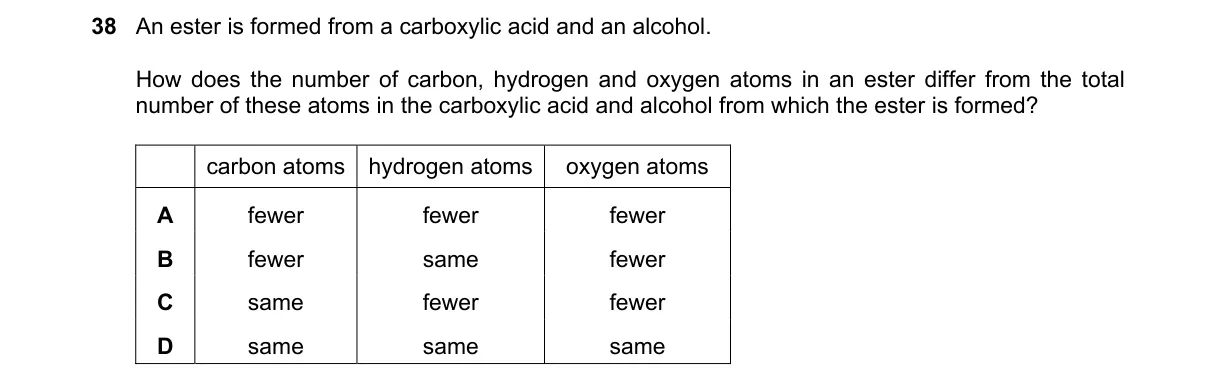
Answer choices
- Afewer carbon atoms, same hydrogen atoms, fewer oxygen atoms
- Bfewer carbon atoms, fewer hydrogen atoms, same oxygen atoms
- Csame carbon atoms, fewer hydrogen atoms, fewer oxygen atoms
- Dsame carbon atoms, same hydrogen atoms, same oxygen atoms
Explanation
Esterification eliminates water from reactants
Steps:
- Carboxylic acid general formula: RCOOH (carbons in R + 1C, hydrogens in R + 1H, 2O).
- Alcohol general formula: R'OH (carbons in R', hydrogens in R' + 1H, 1O).
- Ester formed: RCOOR' (all carbons from both, total H minus 2, total O minus 1) + H2O byproduct.
- Water (H2O) removes 2H and 1O, leaving same total C in ester.
Why C is correct:
- In esterification, RCOOH + R'OH → RCOOR' + H2O, conserving all C atoms while losing 2H and 1O to water.
Why the others are wrong:
- A: Ester retains all C atoms, not fewer.
- B: Ester retains all C atoms and loses 1O, not same O.
- D: Ester loses 2H and 1O, not same totals.
Final answer: C
Topic: Carboxylic acids
Practice more O Levels/IGCSE Chemistry (5070) questions on mMCQ.me