O Levels/IGCSE Chemistry (5070)•5070/11/O/N/18
O Levels/IGCSE Chemistry (5070) — 5070/11/O/N/18, Question 17
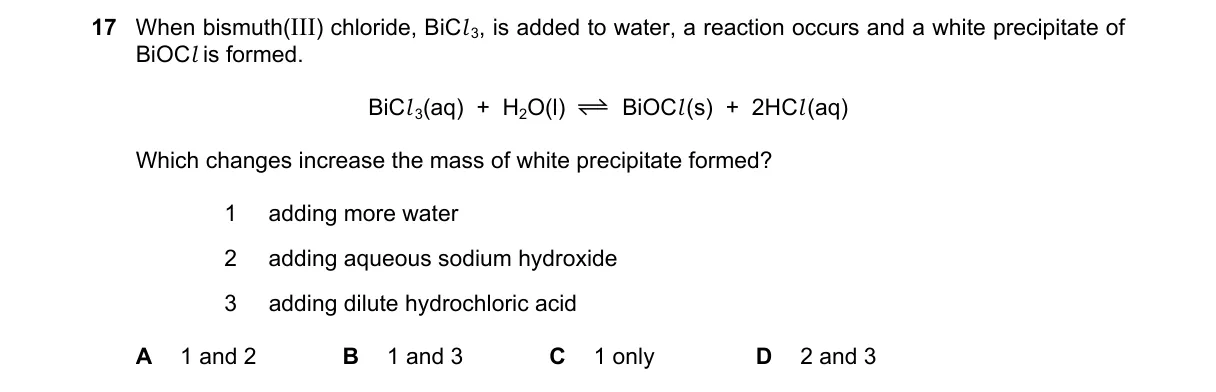
When BiCl3 is added to water, a reaction occurs and a white precipitate of BiOCl is formed. BiCl3(aq) + H2O ⇌ BiOCl(s) + 2HCl(aq) Which changes increase the mass of white precipitate formed? 1 adding more water 2 adding aqueous sodium hydroxide 3 adding dilute hydrochloric acid
Answer choices
- A1 and 2
- B1 and 3
- C1 only
- D2 and 3
Explanation
Le Chatelier's Principle in Precipitation Equilibrium
Steps:
- The equilibrium is BiCl3(aq) + H2O(l) ⇌ BiOCl(s) + 2HCl(aq); increasing BiOCl shifts right.
- Adding more water increases reactant concentration and dilutes products, shifting equilibrium right to form more BiOCl precipitate.
- Adding aqueous NaOH neutralizes HCl (H+ + OH- → H2O), removing a product and shifting equilibrium right to produce more BiOCl.
- Adding dilute HCl increases product concentration, shifting equilibrium left and decreasing BiOCl precipitate.
Why A is correct:
- Both adding water (dilutes products) and NaOH (removes HCl product) drive the equilibrium right per Le Chatelier's principle, increasing BiOCl mass.
Why the others are wrong:
- B includes adding HCl, which increases products and shifts left, reducing precipitate.
- C ignores NaOH's effect in removing HCl to shift right.
- D pairs NaOH (shifts right) with HCl (shifts left), so not both increase precipitate.
Final answer: A
Topic: Reversible reactions and equilibrium
Practice more O Levels/IGCSE Chemistry (5070) questions on mMCQ.me