O Levels/IGCSE Chemistry (5070)•5070/11/O/N/18
O Levels/IGCSE Chemistry (5070) — 5070/11/O/N/18, Question 15
The equation represents the reaction between two gases, X and Y, to form compound XY. X(g) + Y(g) → XY(g) The energy profile diagram for the reaction is shown. Which statement about this reaction is correct?
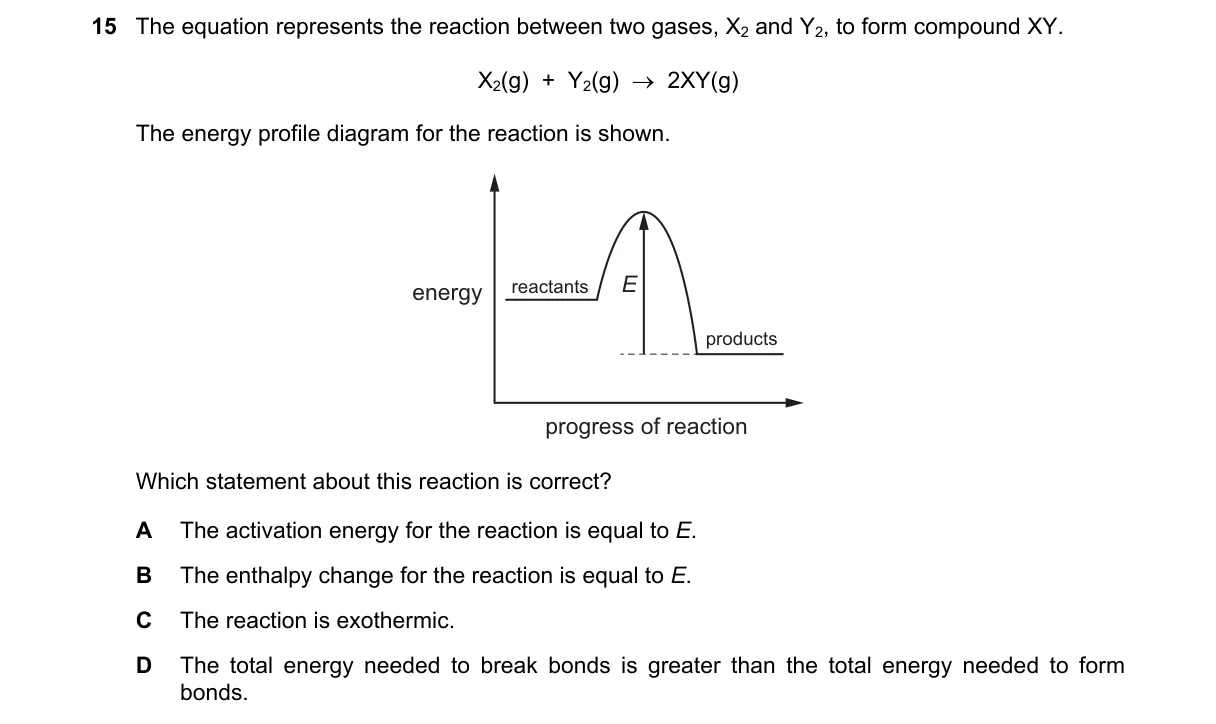
Answer choices
- AThe activation energy for the reaction is equal to E
- BThe enthalpy change for the reaction is equal to E
- CThe reaction is exothermic.
- DThe total energy needed to break bonds is greater than the total energy needed to form bonds.
Explanation
Analyzing Reaction Energy Profiles
Steps:
- Examine the diagram: reactants start at a higher energy level than products, indicating energy release.
- Activation energy is the peak height from reactant level to transition state.
- Enthalpy change (ΔH) is the vertical difference between reactant and product energy levels.
- Compare bond energies: exothermic reactions release more energy forming bonds than breaking them.
Why C is correct:
- Exothermic reactions have negative ΔH, where product energy is lower than reactants, matching the diagram's downward profile (ΔH = E_p - E_r < 0).
Why the others are wrong:
- A: Activation energy is the full barrier from reactants to transition state, exceeding E if E labels only part of it.
- B: Enthalpy change is the net difference between reactant and product levels, not solely E.
- D: Exothermic means energy to form bonds exceeds energy to break them, opposite of the statement.
Final answer: C
Topic: Exothermic and endothermic reactions
Practice more O Levels/IGCSE Chemistry (5070) questions on mMCQ.me