O Levels/IGCSE Chemistry (5070)•5070/12/M/J/25
O Levels/IGCSE Chemistry (5070) — 5070/12/M/J/25, Question 40
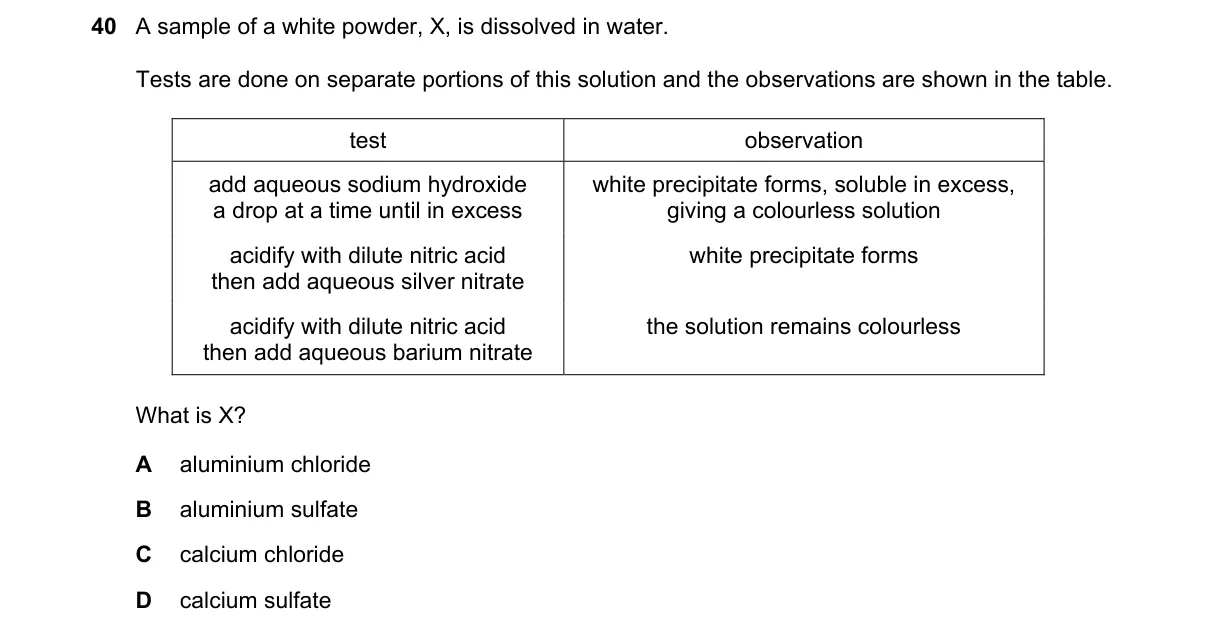
A sample of a white powder, X, is dissolved in water. Tests are done on separate portions of this solution and the observations are shown in the table. add aqueous sodium hydroxide in excess white precipitate forms then add dilute nitric acid giving colourless solution add aqueous silver nitrate white precipitate forms then add aqueous barium nitrate the solution remains colourless What is X?
Answer choices
- Aaluminium chloride
- Baluminium sulfate
- Ccalcium chloride
- Dcalcium sulfate
Explanation
Identification of chloride and amphoteric aluminium ions Steps:
- White precipitate with AgNO₃ confirms Cl⁻ ions (AgCl formation).
- No precipitate with Ba(NO₃)₂ after AgNO₃ test confirms absence of SO₄²⁻ ions.
- White precipitate with excess NaOH indicates Al(OH)₃ formation; its amphoteric nature allows dissolution in excess NaOH to colourless solution, maintained colourless upon adding dilute HNO₃. Why A is correct:
- AlCl₃ provides Al³⁺ (amphoteric Al(OH)₃ dissolves in excess NaOH per the reaction Al(OH)₃ + OH⁻ → [Al(OH)₄]⁻) and Cl⁻ (AgCl precipitate), matching all tests. Why the others are wrong:
- B. Aluminium sulfate has SO₄²⁻, forming white BaSO₄ precipitate.
- C. Calcium chloride's Ca(OH)₂ precipitate insoluble in excess NaOH.
- D. Calcium sulfate has SO₄²⁻ (BaSO₄ precipitate) and lacks Cl⁻ (no AgCl).
Final answer: A
Topic: Identification of ions and gases
Practice more O Levels/IGCSE Chemistry (5070) questions on mMCQ.me