O Levels/IGCSE Chemistry (5070)•5070/12/M/J/25
O Levels/IGCSE Chemistry (5070) — 5070/12/M/J/25, Question 29
Domestic water is treated before it is supplied to houses. These treatments are listed. • Sedimentation and filtration • Treatment with chlorine Which row shows the purpose of the treatments?
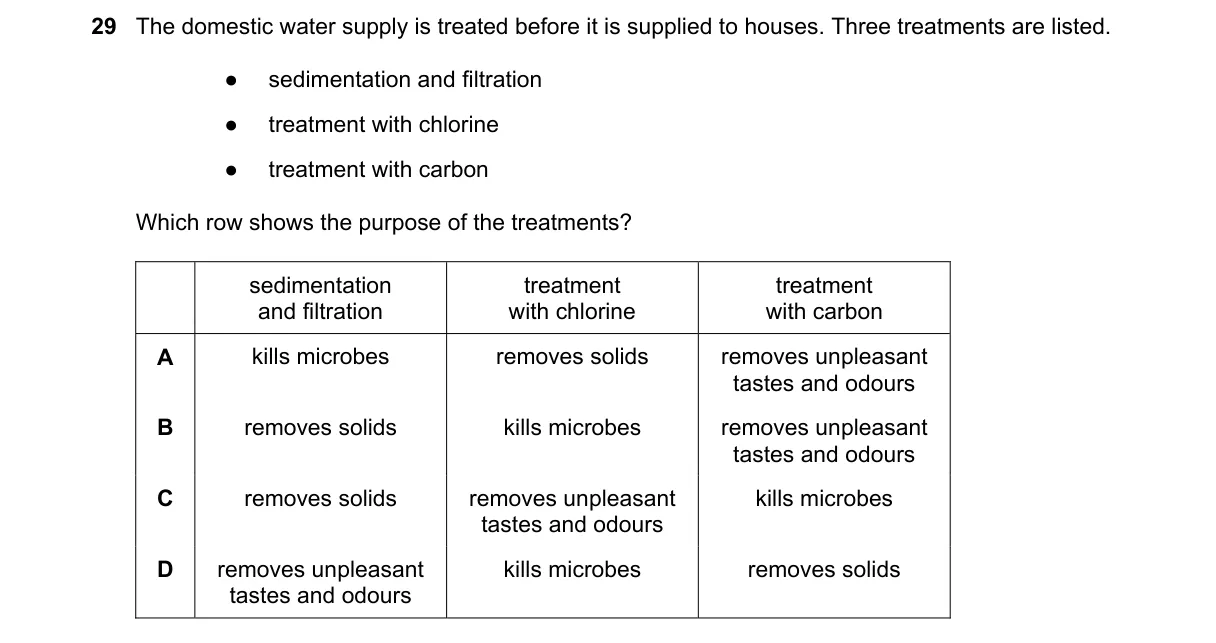
Answer choices
- ASedimentation and filtration kills microbes Treatment with chlorine removes solids Treatment with carbon removes unpleasant tastes and odours
- BSedimentation and filtration removes solids Treatment with chlorine kills microbes Treatment with carbon removes unpleasant tastes and odours
- CSedimentation and filtration removes solids Treatment with chlorine removes unpleasant tastes and odours Treatment with carbon kills microbes
- DSedimentation and filtration removes unpleasant tastes and odours Treatment with chlorine kills microbes Treatment with carbon removes solids
Explanation
Matching Water Treatment Purposes
Steps:
- Sedimentation settles out heavy particles, and filtration traps smaller solids to clarify water.
- Chlorine treatment acts as a disinfectant to kill harmful microbes like bacteria.
- Activated carbon adsorption removes organic compounds causing tastes and odors.
- Compare choices to standard processes: solids removal first, then disinfection, then taste improvement.
Why B is correct:
- Sedimentation and filtration remove suspended solids via physical separation; chlorine kills microbes through oxidation, as per standard water purification definitions.
Why the others are wrong:
- A: Reverses solids removal and microbe killing, ignoring physical vs. chemical roles.
- C: Assigns taste removal to chlorine (disinfectant) and microbe killing to carbon (adsorbent).
- D: Misplaces solids removal to carbon and tastes to initial filtration steps.
Final answer: B
Topic: Water
Practice more O Levels/IGCSE Chemistry (5070) questions on mMCQ.me