O Levels/IGCSE Chemistry (5070)•5070/12/M/J/25
O Levels/IGCSE Chemistry (5070) — 5070/12/M/J/25, Question 15
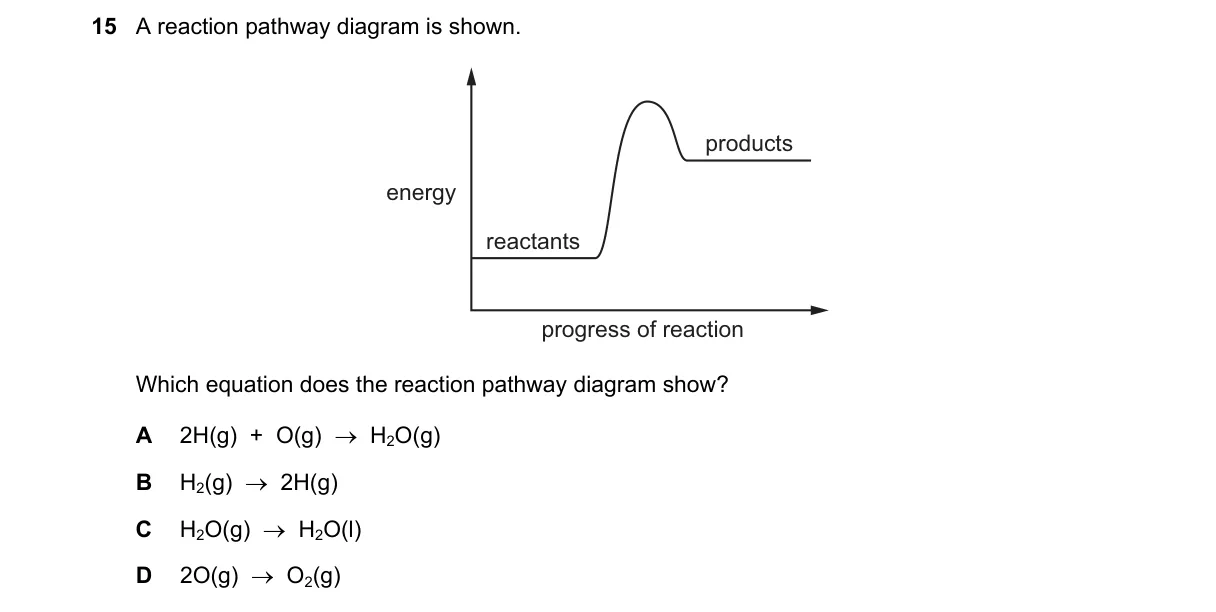
A reaction pathway diagram is shown. Which equation does the reaction pathway diagram show?
Answer choices
- A2H₂(g) + O₂(g) → 2H₂O(g)
- BH₂O(g) → 2H(g) + O(g)
- C2O(g) → O₂(g)
- DH₂O(g) → H₂(g) + ½O₂(g)
Explanation
Reaction pathway diagrams indicate energy changes for specific reactions
Steps:
- Examine the diagram's energy profile: rising energy from reactants to products signals an endothermic reaction.
- Identify reactants and products: water vapor breaking into hydrogen and oxygen atoms matches atomic dissociation.
- Check stoichiometry: 1 H₂O yields 2 H and 1 O, aligning with the pathway's labeled intermediates.
- Confirm direction: forward path shows bond breaking, not formation.
Why B is correct:
- It represents the endothermic dissociation of H₂O(g) into atoms, where energy input breaks O-H bonds, per bond energy definitions.
Why the others are wrong:
- A: Exothermic formation of water, with energy release, opposite of an uphill diagram.
- C: Exothermic recombination of O atoms, showing energy decrease.
- D: Endothermic but produces molecular H₂ and O₂, not atomic products.
Final answer: B
Topic: Exothermic and endothermic reactions
Practice more O Levels/IGCSE Chemistry (5070) questions on mMCQ.me