O Levels/IGCSE Chemistry (5070)•5070/11/M/J/25
O Levels/IGCSE Chemistry (5070) — 5070/11/M/J/25, Question 29
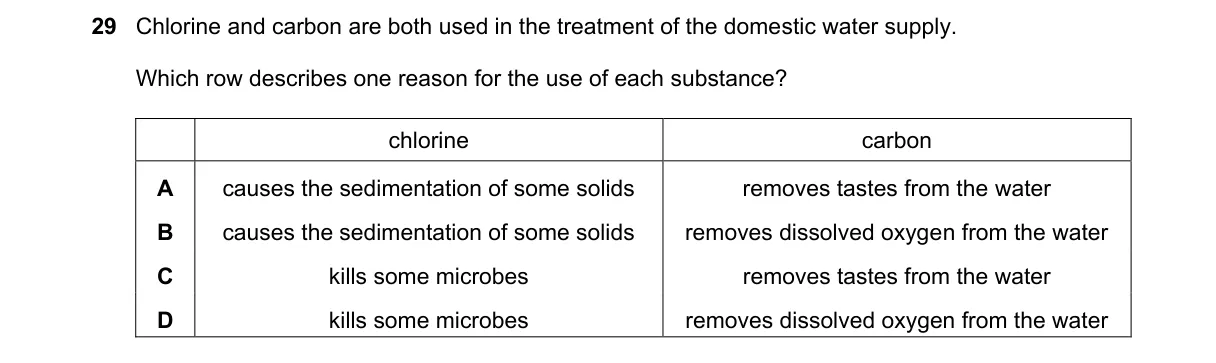
Chlorine and carbon are both used in the treatment of domestic water. Which row describes one use of each substance?
Answer choices
- Acauses the sedimentation of some solids removes dissolved oxygen from the water
- Bcauses the sedimentation of some solids removes dissolved tastes from the water
- Ckills some microbes removes dissolved tastes from the water
- Dkills some microbes removes dissolved oxygen from the water
Explanation
Roles of Chlorine and Carbon in Water Purification
Steps:
- Identify chlorine's primary function: disinfection by killing harmful microbes like bacteria.
- Identify carbon's primary function: adsorption of organic impurities causing tastes and odors.
- Compare options to these roles, focusing on accurate pairings.
- Select the option matching both uses without errors.
Why C is correct:
- Chlorine acts as a disinfectant, oxidizing and killing microbes per standard water treatment protocols; activated carbon removes dissolved tastes via adsorption of volatile organics.
Why the others are wrong:
- A: Chlorine kills microbes, not sediments solids (that's coagulants like alum); carbon adsorbs organics, not oxygen.
- B: Chlorine does not cause sedimentation; carbon removes tastes, not via sedimentation.
- D: Chlorine kills microbes, but carbon adsorbs tastes/odors, not dissolved oxygen (that's aeration or chemicals).
Final answer: C
Topic: Water
Practice more O Levels/IGCSE Chemistry (5070) questions on mMCQ.me