O Levels/IGCSE Chemistry (5070)•5070/11/M/J/25
O Levels/IGCSE Chemistry (5070) — 5070/11/M/J/25, Question 24
Which statement is correct?
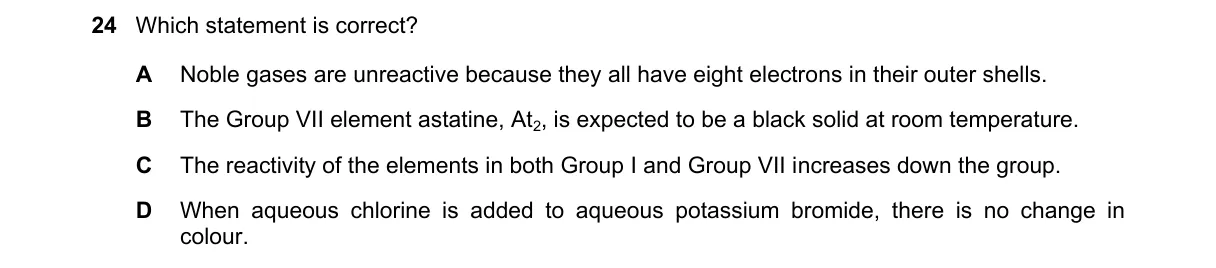
Answer choices
- ANoble gases are unreactive because they all have eight electrons in their outer shells
- BThe Group VII element astatine, At, is expected to be a black solid at room temperature.
- CThe reactivity of elements in both Group I and Group VII increases down the group
- DWhen aqueous chlorine is added to aqueous potassium bromide, there is no change in colour.
Explanation
Trends in Group I, VII, and noble gas properties
Steps:
- Evaluate A: Noble gases unreactive due to full valence shells, but helium has 2 electrons, not 8.
- Evaluate B: Astatine as heaviest halogen follows trend of increasing boiling points down Group VII, predicting solid state.
- Evaluate C: Group I reactivity increases down group due to easier electron loss; Group VII reactivity decreases due to weaker oxidizing power.
- Evaluate D: Chlorine, stronger oxidant than bromine, displaces bromide ions, producing colored Br2.
Why B is correct:
- Halogens' physical states trend from gas to solid down the group due to increasing atomic mass and van der Waals forces; astatine (At, atomic number 85) extrapolates as a black solid like iodine.
Why the others are wrong:
- A: Helium has 2 valence electrons, violating the octet rule claim.
- C: Group VII reactivity decreases down the group as electron affinity weakens.
- D: Displacement reaction Cl2 + 2Br- → Br2 + 2Cl- produces brown bromine color.
Final answer: B
Topic: Group VII properties
Practice more O Levels/IGCSE Chemistry (5070) questions on mMCQ.me