O Levels/IGCSE Chemistry (5070)•5070/11/M/J/25
O Levels/IGCSE Chemistry (5070) — 5070/11/M/J/25, Question 20
The pH of dilute ethanoic acid is measured. The equation for partial dissociation of aqueous ethanoic acid is shown. CH3COOH(aq) ⇌ CH3COO-(aq) + H+(aq) Aqueous sodium ethanoate, CH3COONa, is added to the dilute ethanoic acid and the pH is measured again. What is the initial pH of the dilute ethanoic acid and how does it change after the addition of the aqueous sodium ethanoate?
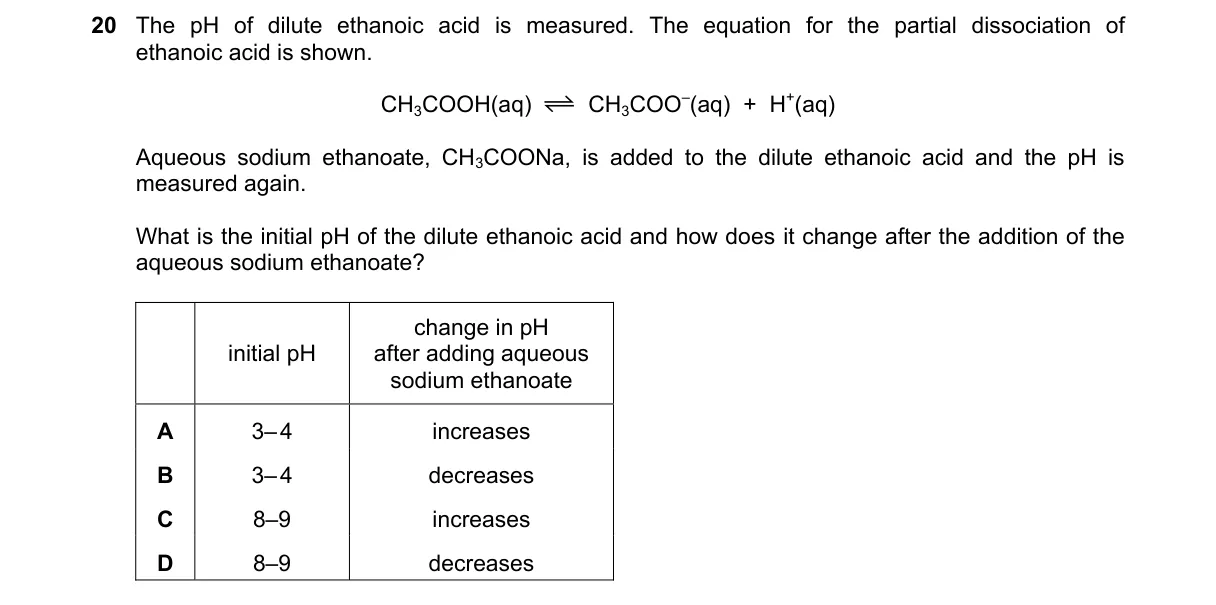
Answer choices
- AInitial pH 3-4; pH increases
- BInitial pH 3-4; pH decreases
- CInitial pH 8-9; pH increases
- DInitial pH 8-9; pH decreases
Explanation
Weak Acid and Common Ion Effect
Steps:
- Ethanoic acid (CH3COOH) is a weak acid; in dilute aqueous solution, it partially dissociates, yielding [H+] ≈ 10^{-3} to 10^{-4} M, so pH 3-4.
- Sodium ethanoate (CH3COONa) fully dissociates to provide CH3COO- ions.
- Added CH3COO- is the common ion, shifting the equilibrium CH3COOH ⇌ CH3COO- + H+ leftward (Le Chatelier's principle).
- Reduced dissociation lowers [H+], increasing pH.
Why A is correct:
- For weak acids, initial pH is acidic (3-4); common ion effect suppresses ionization, decreasing [H+] and raising pH per Le Chatelier's principle.
Why the others are wrong:
- B: pH increases, does not decrease, due to suppressed H+ production.
- C: Initial pH is acidic (3-4), not basic (8-9) for a weak acid solution.
- D: Initial pH is not 8-9, and pH increases rather than decreases.
Final answer: A
Topic: The characteristic properties of acids and bases
Practice more O Levels/IGCSE Chemistry (5070) questions on mMCQ.me