O Levels/IGCSE Chemistry (5070)•5070/11/M/J/25
O Levels/IGCSE Chemistry (5070) — 5070/11/M/J/25, Question 17
The diagram shows apparatus used to investigate two different reactions that produce gases. 5g of X 100 cm³ 1 mol/dm³ HCl The reactants for each experiment are mixed and the mass of flask plus contents for each experiment is recorded every 30 seconds. A graph of the mass against time is drawn. In experiment 1, X is calcium carbonate. In experiment 2, X is magnesium. Which graph
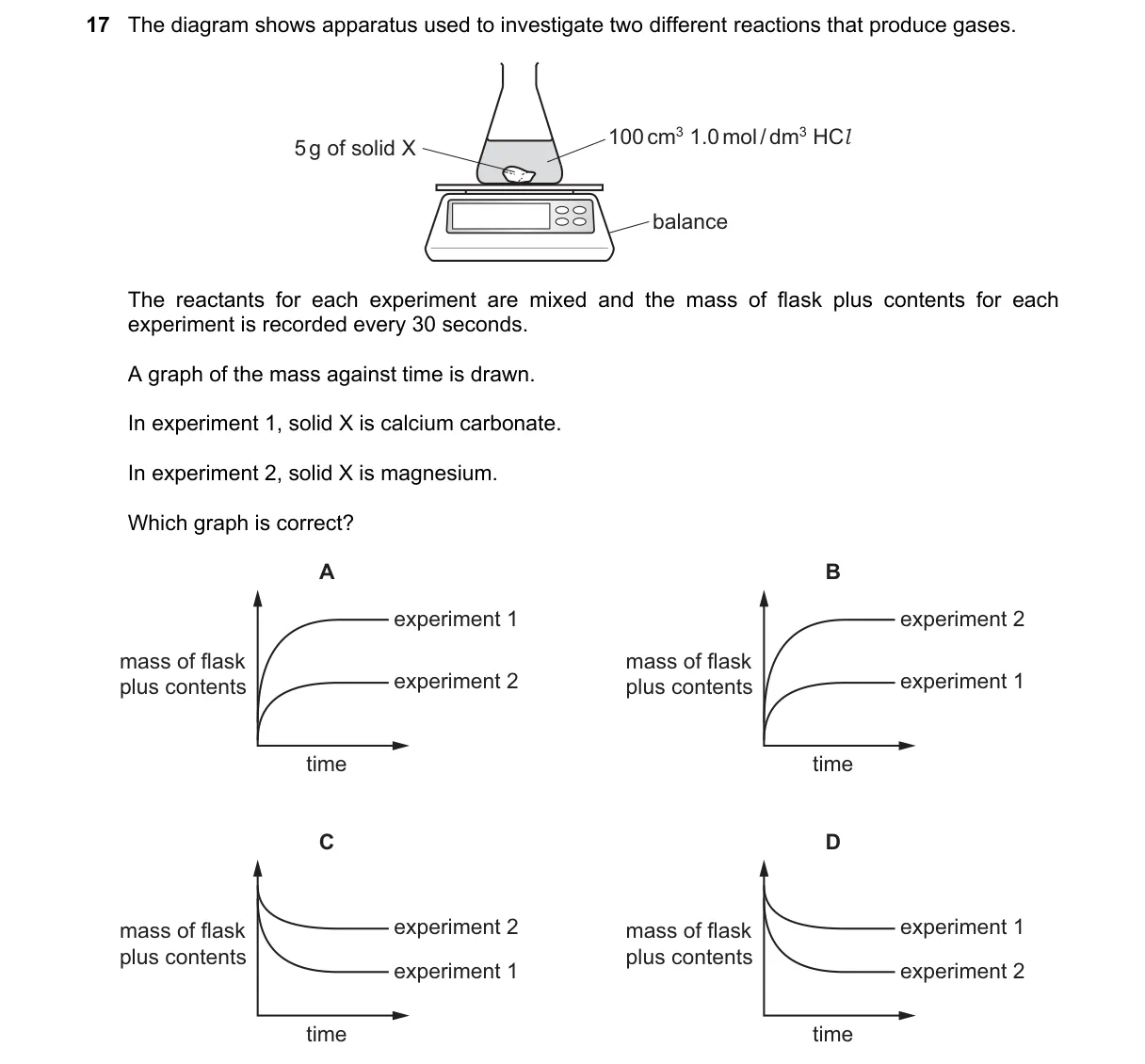
Answer choices
- AOption A
- BOption B
- COption C
- DOption D
Explanation
Reaction rate and mass loss differences between carbonate and metal with acid
Steps:
- Identify reactions: CaCO₃ + 2HCl → CaCl₂ + H₂O + CO₂ (exp 1); Mg + 2HCl → MgCl₂ + H₂ (exp 2).
- Calculate mass loss: 5g CaCO₃ (0.05 mol) produces 0.05 mol CO₂ (2.2g loss); 5g Mg (0.208 mol) produces 0.104 mol H₂ (0.208g loss).
- Compare rates: Carbonate-acid reaction is faster (rapid effervescence) than Mg-acid (slower initial rate with 1 mol/dm³ HCl).
- Predict graphs: Exp 1 shows steeper initial slope and larger total drop; exp 2 shows shallower slope and smaller drop.
Why C is correct:
- Matches stoichiometry: Larger CO₂ mass loss (from formula CaCO₃ + 2HCl → CO₂) versus smaller H₂ loss (Mg + 2HCl → H₂), with faster CaCO₃ rate per collision theory.
Why the others are wrong:
- A: Reverses rates, showing slower CaCO₃ drop.
- B: Equal mass losses, ignoring molar mass differences.
- D: Similar slopes, overlooking reaction speed variance.
Final answer: C
Topic: Rate of reaction
Practice more O Levels/IGCSE Chemistry (5070) questions on mMCQ.me