O Levels/IGCSE Chemistry (5070)•5070/11/M/J/25
O Levels/IGCSE Chemistry (5070) — 5070/11/M/J/25, Question 16
Which row is correct for a chemical reaction in which ΔH is negative?
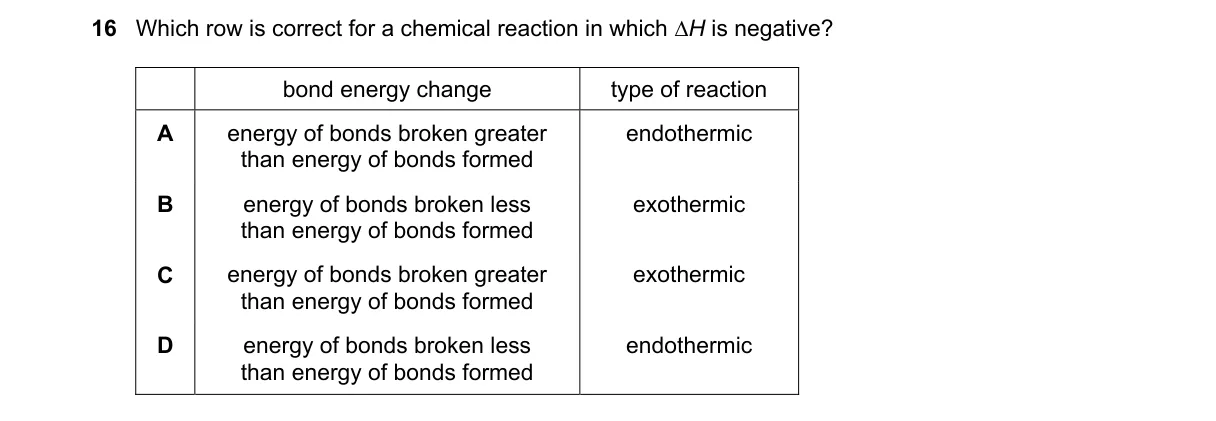
Answer choices
- Aenergy of bonds broken greater than energy of bonds formed, exothermic
- Benergy of bonds broken less than energy of bonds formed, exothermic
- Cenergy of bonds broken greater than energy of bonds formed, endothermic
- Denergy of bonds broken less than energy of bonds formed, endothermic
Explanation
Bond Energies Determine Enthalpy Change
Steps:
- ΔH negative indicates an exothermic reaction, releasing energy.
- Breaking bonds absorbs energy; forming bonds releases energy.
- Overall ΔH = (energy of bonds broken) - (energy of bonds formed).
- For ΔH < 0, energy of bonds formed exceeds energy of bonds broken.
Why B is correct:
- Matches ΔH = bonds broken - bonds formed < 0, where bonds formed > bonds broken, defining an exothermic process.
Why the others are wrong:
- A: Energy of bonds broken > formed means ΔH > 0 (endothermic), not exothermic.
- C: Energy of bonds broken > formed correctly describes endothermic (ΔH > 0), irrelevant to ΔH < 0.
- D: Energy of bonds broken < formed means exothermic (ΔH < 0), but wrongly labeled endothermic.
Final answer: B
Topic: Exothermic and endothermic reactions
Practice more O Levels/IGCSE Chemistry (5070) questions on mMCQ.me