O Levels/IGCSE Chemistry (5070)•5070/12/M/J/24
O Levels/IGCSE Chemistry (5070) — 5070/12/M/J/24, Question 18
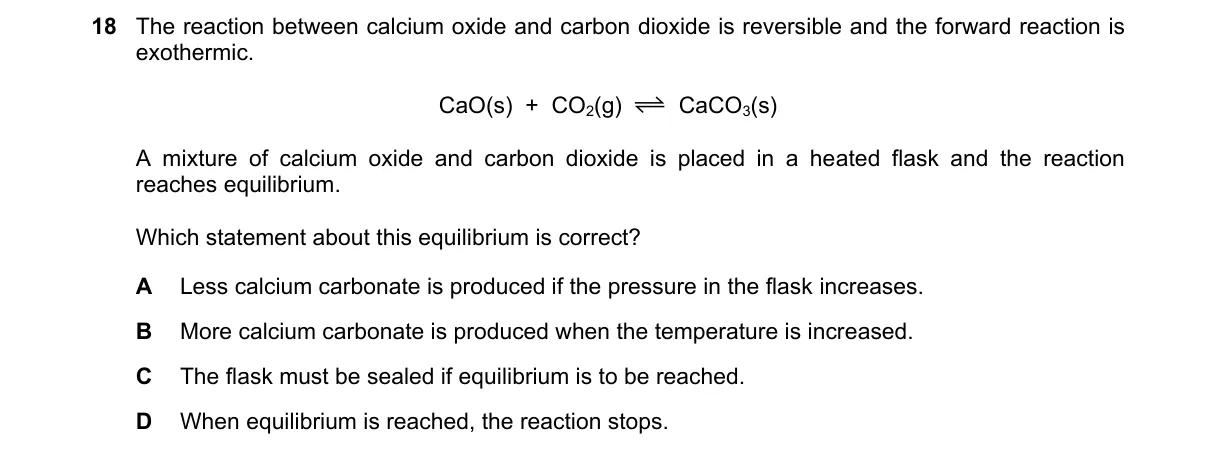
The reaction between calcium oxide and carbon dioxide is reversible and the forward reaction is exothermic. A mixture of calcium oxide and carbon dioxide is placed in a heat flask and the reaction reaches equilibrium.
Answer choices
- ALess calcium carbonate is produced if the pressure in the flask increases.
- BMore calcium carbonate is produced when temperature is increased.
- CThe flask must be sealed for equilibrium to be reached.
- DWhen equilibrium is reached, the reaction stops.
Explanation
Equilibrium Requires a Closed System
Steps:
- Identify the reaction: CaO(s) + CO2(g) ⇌ CaCO3(s), forward exothermic, 1 mol gas to 0 mol gas.
- Apply Le Chatelier's principle: increased pressure shifts equilibrium right (more CaCO3); increased temperature shifts left (less CaCO3).
- Note equilibrium definition: forward and reverse rates equal in a closed system, reaction continues dynamically.
- Evaluate options: only C ensures no loss of gases for equilibrium.
Why C is correct:
- Equilibrium in reversible gas reactions requires a sealed (closed) system to prevent reactant/product escape, per the definition of dynamic equilibrium.
Why the others are wrong:
- A: Higher pressure decreases gas moles, favoring forward reaction and producing more CaCO3 (Le Chatelier's principle).
- B: Exothermic forward reaction means higher temperature favors endothermic reverse, producing less CaCO3 (Le Chatelier's principle).
- D: At equilibrium, forward and reverse rates are equal but ongoing; net change is zero, not stopped.
Final answer: C
Topic: Reversible reactions and equilibrium
Practice more O Levels/IGCSE Chemistry (5070) questions on mMCQ.me