O Levels/IGCSE Chemistry (5070)•5070/12/M/J/24
O Levels/IGCSE Chemistry (5070) — 5070/12/M/J/24, Question 15
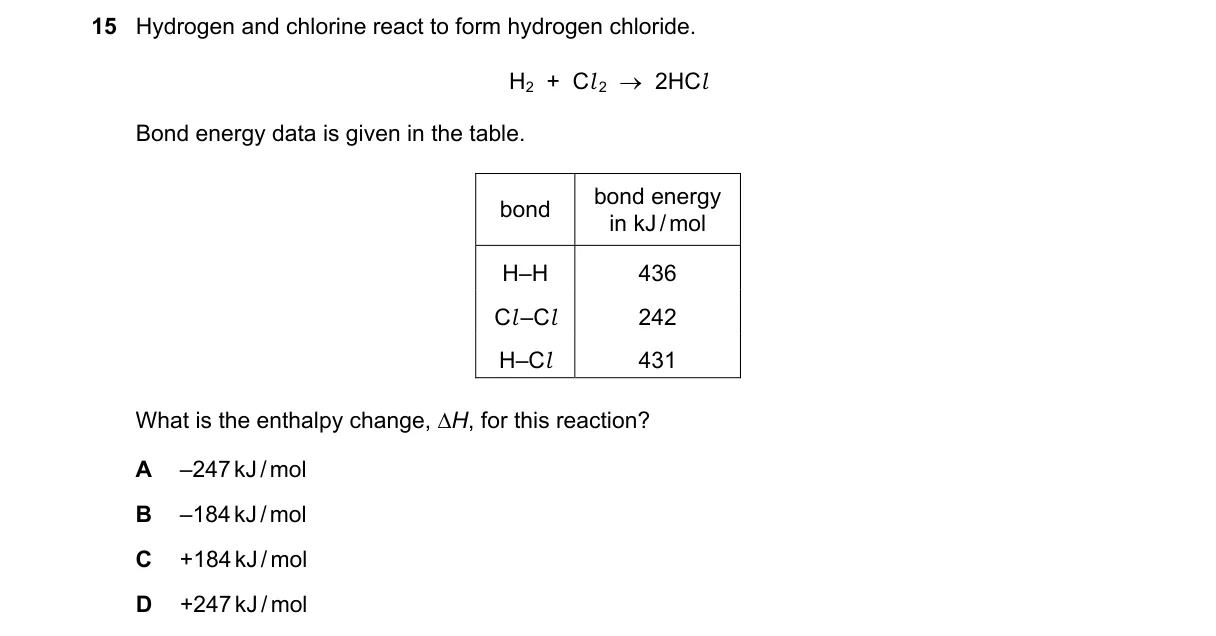
Hydrogen and chlorine react to form hydrogen chloride. H₂ + Cl₂ → 2HCl Bond energy data is given in the table. Bond energy (kJ/mol) H-H 436 Cl-Cl 242 H-Cl 431 What is the enthalpy change, ΔH, for this reaction?
Answer choices
- A-436 kJ/mol
- B-184 kJ/mol
- C+184 kJ/mol
- D+436 kJ/mol
Explanation
Enthalpy Change via Bond Energies Steps:
- Identify bonds broken: one H-H (436 kJ/mol) and one Cl₂ (242 kJ/mol); total energy input = 436 + 242 = 678 kJ/mol.
- Identify bonds formed: two H-Cl (431 kJ/mol each); total energy released = 2 × 431 = 862 kJ/mol.
- Calculate ΔH = energy to break bonds - energy from forming bonds = 678 - 862 = -184 kJ/mol.
- The negative value indicates an exothermic reaction.
Why B is correct:
- ΔH = -184 kJ/mol matches the calculation using the bond energy formula: sum of broken bonds minus sum of formed bonds.
Why the others are wrong:
- A: Ignores Cl-Cl bond and forming energies, underestimating the exothermic nature.
- C: Reverses the sign, treating the reaction as endothermic.
- D: Only considers H-H bond energy, ignoring all other bonds.
Final answer: B
Topic: Exothermic and endothermic reactions
Practice more O Levels/IGCSE Chemistry (5070) questions on mMCQ.me