O Levels/IGCSE Chemistry (5070)•5070/12/M/J/24
O Levels/IGCSE Chemistry (5070) — 5070/12/M/J/24, Question 1
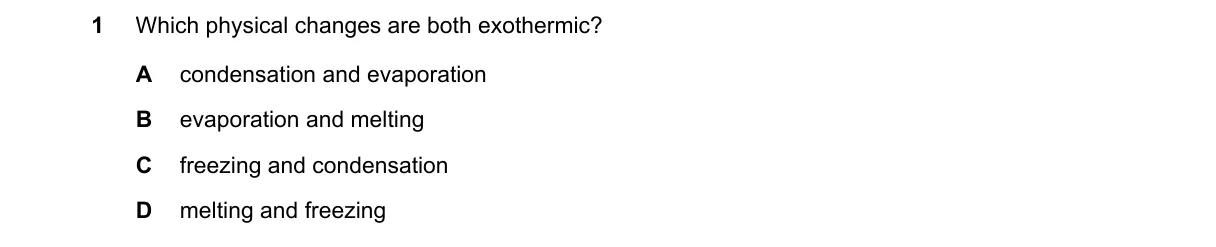
Which physical changes are exothermic?
Answer choices
- Acondensation and evaporation
- Bevaporation and melting
- Cfreezing and condensation
- Dmelting and freezing
Explanation
Exothermic phase changes release heat energy
Steps:
- Exothermic processes release heat to the surroundings during physical changes like phase transitions.
- Identify exothermic changes: freezing (liquid to solid) and condensation (gas to liquid) release heat as particles form stronger bonds.
- Identify endothermic changes: melting (solid to liquid) and evaporation (liquid to gas) absorb heat to break bonds.
- Evaluate options: only C pairs two exothermic processes.
Why C is correct:
- Freezing and condensation are exothermic per the definition of phase changes where decreased molecular disorder releases thermal energy, following the second law of thermodynamics.
Why the others are wrong:
- A: Evaporation absorbs heat (endothermic).
- B: Both evaporation and melting absorb heat (endothermic).
- D: Melting absorbs heat (endothermic).
Final answer: C
Topic: Exothermic and endothermic reactions
Practice more O Levels/IGCSE Chemistry (5070) questions on mMCQ.me