O Levels/IGCSE Chemistry (5070)•5070/11/M/J/24
O Levels/IGCSE Chemistry (5070) — 5070/11/M/J/24, Question 5
Statements about graphite and silicon(IV) oxide, SiO2, are given. Which statement is correct?
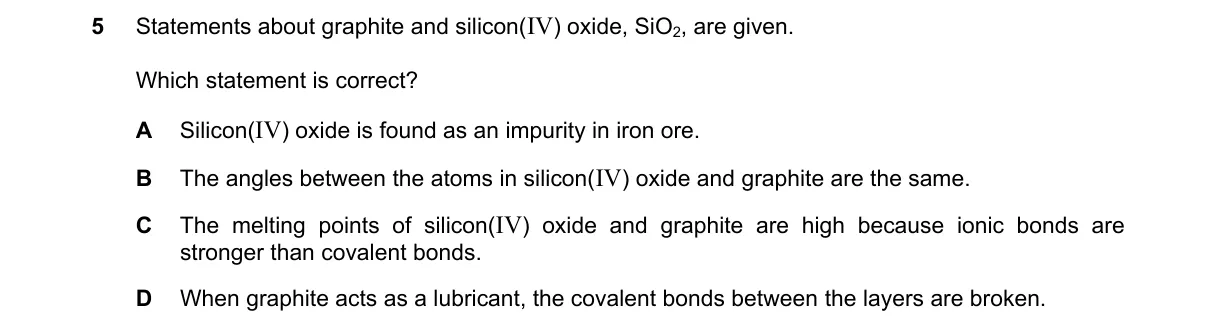
Answer choices
- ASilicon(IV) oxide is found as an impurity in iron ore.
- BThe melting points of silicon(IV) oxide and graphite are high because ionic bonds are stronger than covalent bonds.
- CThe angles between the Si-O bonds in silicon(IV) oxide and graphite are the same.
- DWhen graphite acts as a lubricant, the covalent bonds between layers are broken.
Explanation
Evaluating properties of graphite and SiO₂
Steps:
- Identify SiO₂ as a giant covalent structure with strong Si-O bonds, common in minerals like quartz.
- Recognize graphite as layered carbon sheets with covalent C-C bonds within layers and weak van der Waals forces between.
- Note SiO₂ occurs as silica impurity in iron ores such as hematite.
- Assess each statement against these structures and real-world uses.
Why A is correct:
- SiO₂ (silica) is a principal impurity in iron ore, forming slag with calcium oxide during extraction, as per metallurgical processes.
Why the others are wrong:
- B: High melting points result from strong covalent network bonds in both, not ionic bonds (SiO₂ and graphite are covalent).
- C: Si-O bond angles in SiO₂ are tetrahedral (109.5°), while graphite has trigonal planar C-C angles (120°).
- D: Lubrication occurs via sliding between layers due to weak van der Waals forces, not breaking covalent bonds.
Final answer: A
Topic: Giant covalent structures
Practice more O Levels/IGCSE Chemistry (5070) questions on mMCQ.me