O Levels/IGCSE Chemistry (5070)•5070/11/M/J/24
O Levels/IGCSE Chemistry (5070) — 5070/11/M/J/24, Question 36
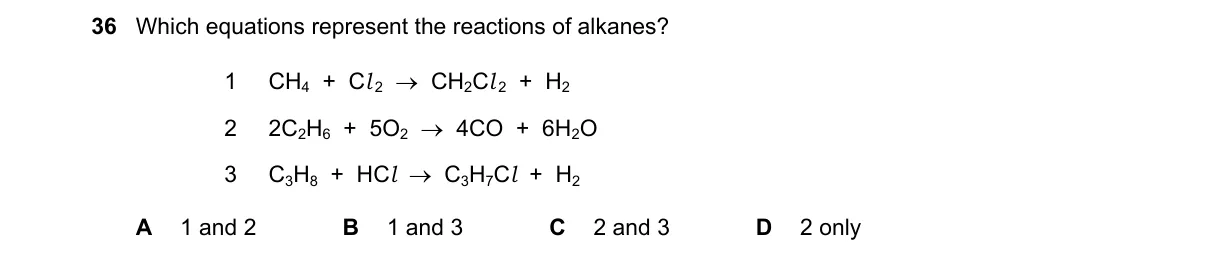
Which equations represent the reactions of alkanes?
1 CH₄ + Cl₂ → CH₃Cl + HCl
2 C₂H₆ + Cl₂ → C₂H₅Cl + HCl
3 CH₄ + HCl → CH₃Cl + H₂
Answer choices
- A1 and 2
- B1 and 3
- C2 and 3
- D2 only
Explanation
Free Radical Substitution in Alkanes
Steps:
- Alkanes undergo free radical substitution with halogens like Cl₂ under UV light, replacing one hydrogen with a halogen atom.
- Equation 1: CH₄ + Cl₂ → CH₃Cl + HCl represents substitution on methane, a valid alkane reaction.
- Equation 2: C₂H₆ + Cl₂ → C₂H₅Cl + HCl represents substitution on ethane, also valid for alkanes.
- Equation 3: CH₄ + HCl → CH₃Cl + H₂ is invalid, as alkanes do not react directly with HCl; this resembles an impossible reversal of substitution.
Why A is correct:
- Option A identifies both 1 and 2 as standard free radical chlorination reactions, per the mechanism where Cl• abstracts H from alkane, followed by Cl₂ forming RCl.
Why the others are wrong:
- B includes 3, which violates alkane reactivity; no free radical or ionic path supports CH₄ + HCl.
- C includes 3, ignoring that alkanes lack reactivity toward HCl alone.
- D excludes 1, but methane undergoes the same substitution as longer alkanes.
Final answer: A
Topic: Alkanes
Practice more O Levels/IGCSE Chemistry (5070) questions on mMCQ.me