O Levels/IGCSE Chemistry (5070)•5070/11/M/J/24
O Levels/IGCSE Chemistry (5070) — 5070/11/M/J/24, Question 32
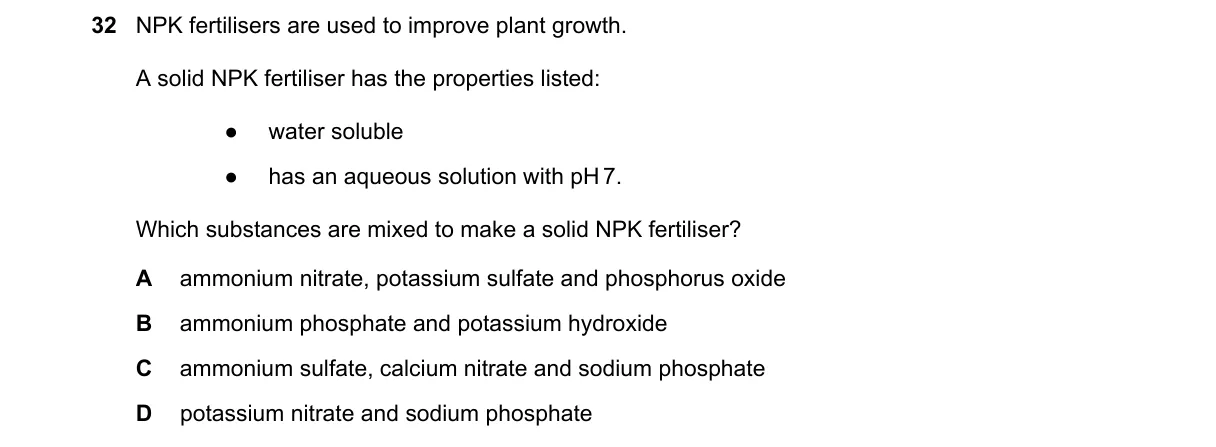
A solid NPK fertilizer has the properties listed: • Water soluble • has aqueous solution with pH7. Which substances are mixed to make a solid NPK fertilizer?
Answer choices
- Aammonium nitrate, potassium sulfate and phosphorus oxide
- Bammonium phosphate and potassium nitrate
- Cammonium sulfate, calcium nitrate and sodium phosphate
- Dpotassium nitrate and sodium phosphate
Explanation
Neutral pH requires soluble salts without acidic ammonium ions or insoluble products Steps:
- Identify NPK sources: Nitrogen from nitrates/ammonium, phosphorus from phosphates, potassium from nitrates/sulfates.
- Ensure water solubility: All components must dissolve fully without precipitates.
- Check pH 7: Avoid acidic (ammonium/sulfate) or strongly basic/unbalanced salts; neutral nitrates and buffered phosphates work.
- Evaluate options for N, P, K coverage, solubility, and neutrality.
Why D is correct:
- Potassium nitrate (KNO3) provides neutral N and K; sodium phosphate (as buffered Na2HPO4/NaH2PO4) provides P at pH 7 per Henderson-Hasselbalch equation for phosphate buffer.
Why the others are wrong:
- A: Phosphorus oxide (P4O10) reacts with water to form acidic H3PO4 (pH <7) and is not directly soluble.
- B: Ammonium phosphate hydrolyzes to release NH4+ and H+, yielding acidic solution (pH ~4-5).
- C: Ammonium sulfate is acidic (NH4+ hydrolysis); Ca2+ and PO43- form insoluble Ca3(PO4)2 precipitate.
Final answer: D
Topic: Fertilisers
Practice more O Levels/IGCSE Chemistry (5070) questions on mMCQ.me