O Levels/IGCSE Chemistry (5070)•5070/11/M/J/24
O Levels/IGCSE Chemistry (5070) — 5070/11/M/J/24, Question 24
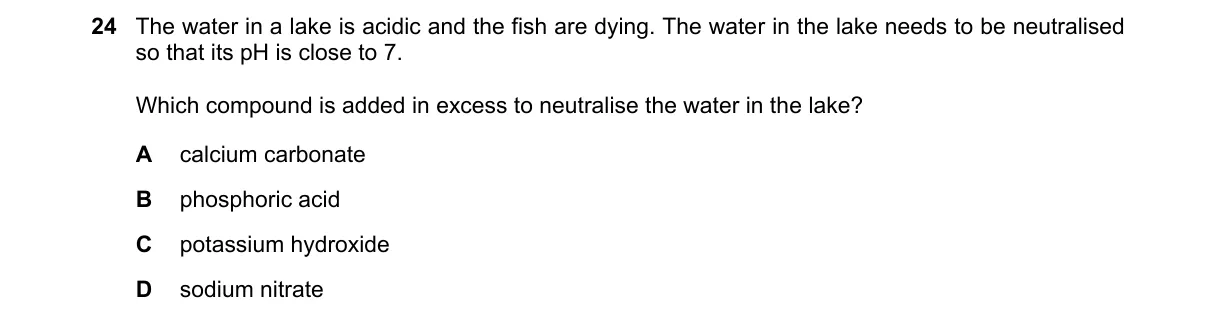
The water in a lake is acidic and the fish are dying. The water in the lake needs to be neutralised so that its pH is close to 7. Which compound added in excess would neutralise the water in the lake?
Answer choices
- Acalcium carbonate
- Bphosphoric acid
- Cpotassium hydroxide
- Dsodium nitrate
Explanation
Neutralizing acidic water with a base
Steps:
- Identify the problem: Lake water is acidic (pH < 7), harming fish; neutralization targets pH ≈ 7.
- Determine requirement: Add a compound that reacts with H⁺ ions to raise pH without overshooting when added in excess.
- Evaluate options: Select a mild base suitable for aquatic environments, like those used in liming lakes.
- Confirm choice: Calcium carbonate provides buffering action for stable pH control.
Why A is correct:
- Calcium carbonate (CaCO₃) is a weak base that reacts with acids via CaCO₃ + 2H⁺ → Ca²⁺ + H₂O + CO₂, neutralizing H⁺ ions and forming harmless products, commonly used in lake liming to buffer pH near 7 even in excess.
Why the others are wrong:
- B: Phosphoric acid (H₃PO₄) is an acid that adds H⁺, lowering pH further.
- C: Potassium hydroxide (KOH) is a strong base; excess addition would raise pH >7, making water alkaline.
- D: Sodium nitrate (NaNO₃) is a neutral salt with no acid-base reaction, so it has no neutralizing effect.
Final answer: A
Topic: The characteristic properties of acids and bases
Practice more O Levels/IGCSE Chemistry (5070) questions on mMCQ.me