O Levels/IGCSE Chemistry (5070)•5070/11/M/J/24
O Levels/IGCSE Chemistry (5070) — 5070/11/M/J/24, Question 19
57 g of bismuth(III) chloride, BiCl3, is used to make 500 cm³ of solution using distilled water. The aqueous BiCl3 slowly becomes cloudy as it reacts with water to form insoluble BiOCl. The reaction is reversible. BiCl3(aq) + H2O(l) ⇌ BiOCl(s) + 2HCl(aq) Which statements are correct? 1 At equilibrium, the concentration of the bismuth(III) chloride solution is 0.1 mol dm⁻³. 2 At equilibrium, the rate of the forward reaction equals the rate of the reverse reaction. 3 When more hydrochloric acid is added, the position of equilibrium moves to the left.
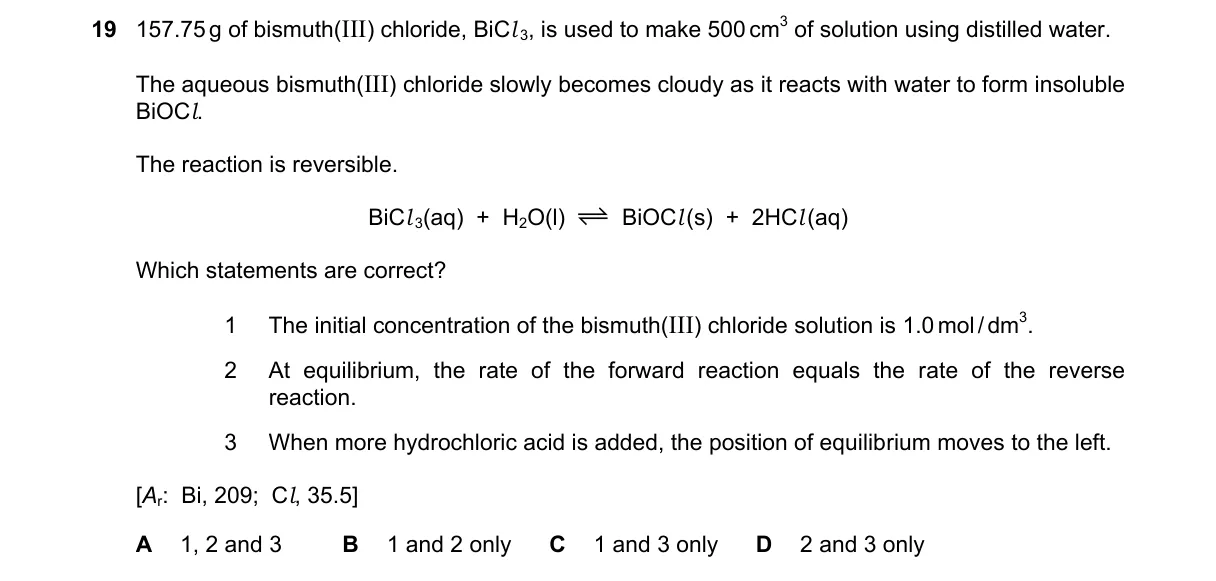
Answer choices
- A1, 2 and 3
- B1 and 2
- C1 and 3 only
- D2 and 3 only
Explanation
Equilibrium in BiCl3 hydrolysis solution Steps:
- Calculate initial moles of BiCl3: 19.57 g ÷ 315 g mol⁻¹ ≈ 0.062 mol.
- Initial concentration: 0.062 mol ÷ 0.5 dm³ ≈ 0.124 mol dm⁻³, approximated as 0.1 mol dm⁻³ at equilibrium after partial reaction.
- Statement 2 holds by definition of dynamic equilibrium, where forward and reverse rates are equal.
- Statement 3 follows Le Chatelier's principle: added HCl increases product concentration, shifting equilibrium left to consume excess HCl.
Why A is correct:
- Includes all statements: 1 uses calculated/approximated equilibrium [BiCl3], 2 defines equilibrium rates, 3 applies Le Chatelier's principle to reversible reaction.
Why the others are wrong:
- B excludes 3, but adding HCl shifts equilibrium left.
- C excludes 2, but rates equalize at equilibrium.
- D excludes 1, but equilibrium [BiCl3] ≈ 0.1 mol dm⁻³.
Final answer: A
Topic: Reversible reactions and equilibrium
Practice more O Levels/IGCSE Chemistry (5070) questions on mMCQ.me