O Levels/IGCSE Chemistry (5070)•5070/11/M/J/24
O Levels/IGCSE Chemistry (5070) — 5070/11/M/J/24, Question 18
Excess aluminium reacts with dilute hydrochloric acid. 2Al + 6HCl → 2AlCl₃ + 3H₂ The hydrogen given off is collected in a gas syringe. The total volume of hydrogen in the gas syringe is recorded every two minutes. The results of this experiment are shown. time/min | total volume /cm³ 0 | 0 2 | 4 4 | 6 6 | 53 8 | 131 12 | 143 14 | 143 Which statement is correct?
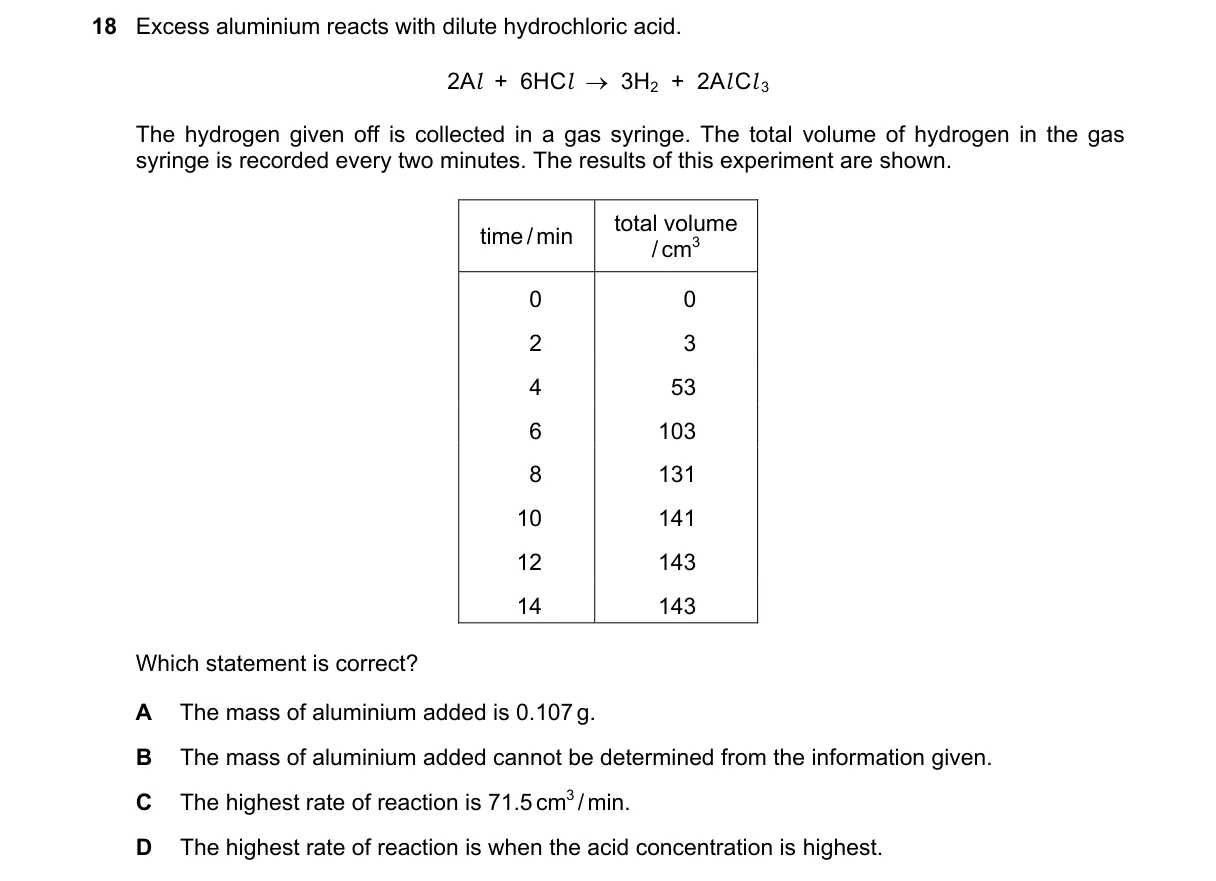
Answer choices
- AThe mass of aluminium added is 0.107 g.
- BThe mass of aluminium added is 0.15 g/min. from the information given.
- CThe highest rate of reaction is 7.15 cm³/min.
- DThe highest rate of reaction is when the acid concentration is highest.
Explanation
Stoichiometric calculation of aluminum mass from hydrogen volume Steps:
- Total H₂ volume is 143 cm³; moles H₂ = 143 / 24,000 = 0.00596 mol (using 24,000 cm³/mol).
- From 2Al + 6HCl → 2AlCl₃ + 3H₂, moles Al = (2/3) × 0.00596 mol = 0.00397 mol.
- Mass Al = 0.00397 mol × 27 g/mol = 0.107 g.
- This matches the fixed mass added, as reaction goes to completion with excess Al.
Why A is correct:
- It uses the stoichiometric ratio and ideal gas molar volume to find the exact mass from total product gas.
Why the others are wrong:
- B: Mass is a one-time addition, not a rate (g/min); data shows fixed amount, not continuous feeding.
- C: Highest rate is (131 - 53) cm³ / 2 min = 39 cm³/min between 6–8 min.
- D: Initial rate is slowest (high acid concentration), but accelerates later, likely due to Al oxide layer dissolving.
Final answer: A
Topic: Rate of reaction
Practice more O Levels/IGCSE Chemistry (5070) questions on mMCQ.me