O Levels/IGCSE Chemistry (5070)•5070/11/M/J/24
O Levels/IGCSE Chemistry (5070) — 5070/11/M/J/24, Question 15
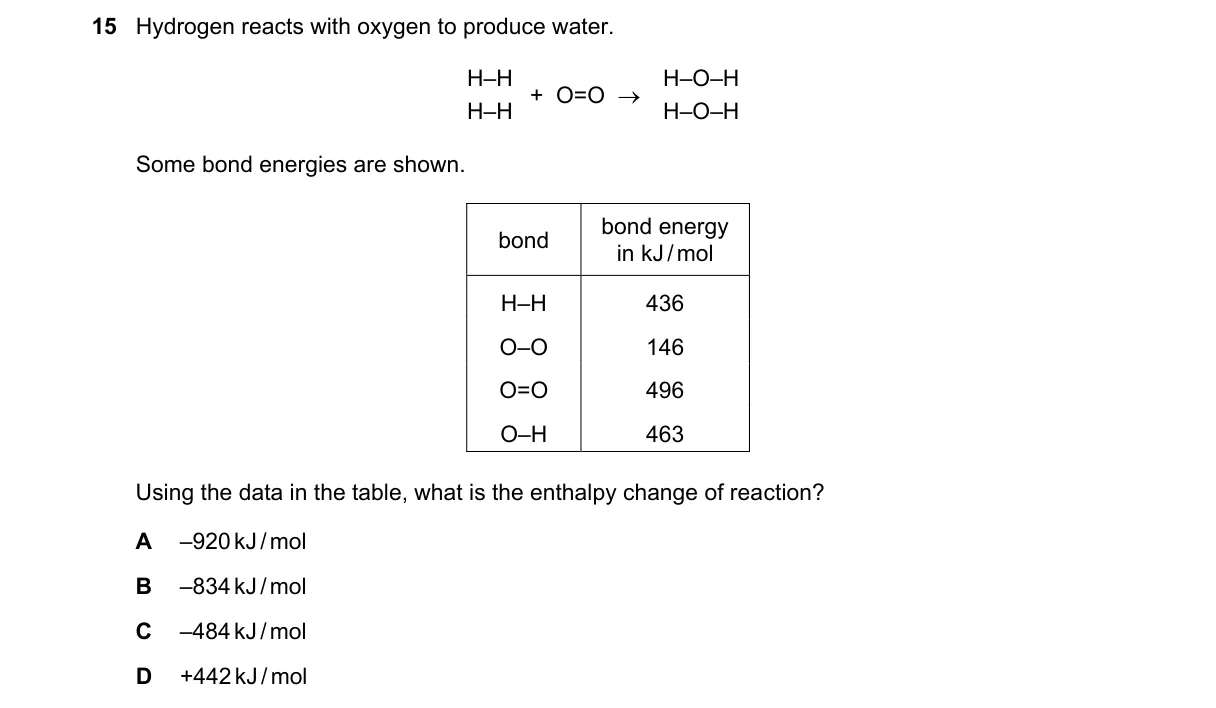
Hydrogen reacts with oxygen to produce water.
H-H + O=O → H-O-H
H
Some bond energies are shown.
| bond | bond energy (kJ/mol) |
| H-H | 436 |
| O-H | 463 |
| O=O | 496 |
Using the data in the table, what is the enthalpy change of reaction?
Answer choices
- A-920 kJ/mol
- B-484 kJ/mol
- C442 kJ/mol
- D484 kJ/mol
Explanation
Bond Enthalpy Calculation for Water Formation Steps:
- Balance the reaction: 2H₂ + O₂ → 2H₂O (bonds: break 2 H-H and 1 O=O; form 4 O-H).
- Calculate bonds broken energy: (2 × 436 kJ/mol) + 496 kJ/mol = 1368 kJ/mol.
- Calculate bonds formed energy: 4 × 463 kJ/mol = 1852 kJ/mol.
- Compute ΔH: 1368 kJ/mol - 1852 kJ/mol = -484 kJ/mol.
Why B is correct:
- Matches the bond enthalpy formula ΔH = Σ(bond energies broken) - Σ(bond energies formed), indicating exothermic reaction.
Why the others are wrong:
- A: Uses only 1 H-H bond broken (436 + 496 - 1852 = -920), ignoring stoichiometry for 2H₂O.
- C: Subtracts only 2 O-H bonds (1368 - 926 = 442), undercounting bonds formed in 2H₂O.
- D: Reverses sign of correct calculation, treating reaction as endothermic.
Final answer: B
Topic: Exothermic and endothermic reactions
Practice more O Levels/IGCSE Chemistry (5070) questions on mMCQ.me