O Levels/IGCSE Chemistry (5070) — 5070/11/M/J/24, Question 10
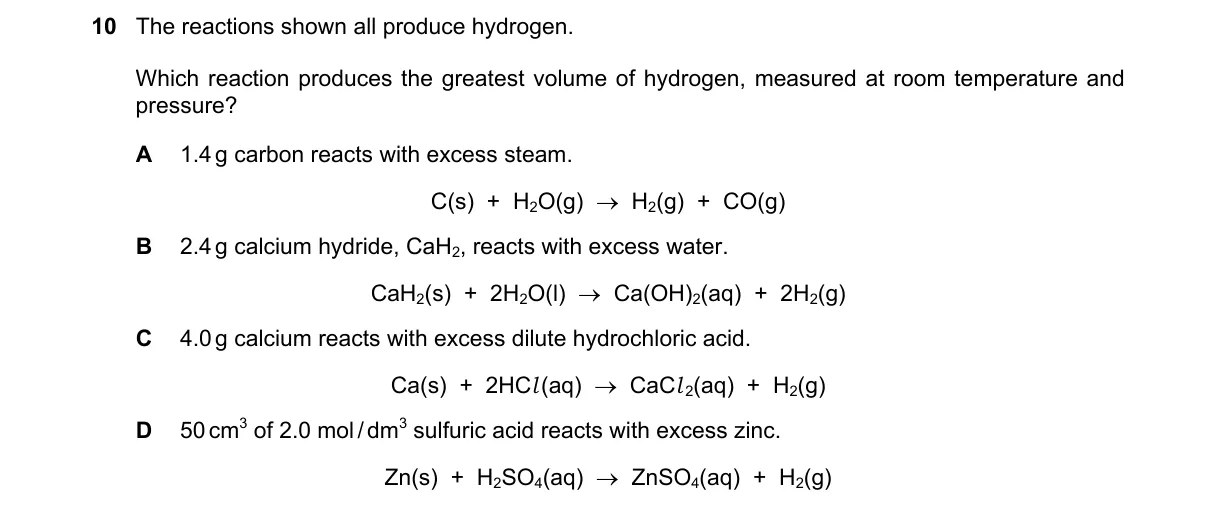
Answer choices
- A1.4 g reacts with excess steam. H2O(g) -> ?
- B2.4 g calcium hydride, CaH2(s) + H2O(l) -> Ca(OH)2(aq) + H2(g)
- C4.0 g calcium, Ca(s) + 2H2O(l) -> Ca(OH)2(aq) + H2(g)
- D50 cm³ of 2 mol dm⁻³ sulfuric acid, Zn(s) + H2SO4(aq) -> ZnSO4(aq) + H2(g)
Explanation
Compare moles of H₂ produced to find greatest volume at RTP Steps: - For A: 1.4 g C (molar mass 12 g mol⁻¹) = 1.4/12 = 0.117 mol; C + H₂O(g) → CO + H₂ (1:1 ratio) gives 0.117 mol H₂. - For B: 2.4 g CaH₂ (molar mass 42 g mol⁻¹) = 2.4/42 ≈ 0.057 mol; CaH₂ + 2H₂O → Ca(OH)₂ + 2H₂ (1:2 ratio) gives 0.114 mol H₂. - For C: 4.0 g Ca (molar mass 40 g mol⁻¹) = 4.0/40 = 0.10 mol; Ca + 2H₂O → Ca(OH)₂ + H₂ (1:1 ratio) gives 0.10 mol H₂. - For D: 50 cm³ = 0.050 dm³ of 2 mol dm⁻³ H₂SO₄ = 0.10 mol; Zn + H₂SO₄ → ZnSO₄ + H₂ (1:1 ratio, acid limiting) gives 0.10 mol H₂. - A produces the most moles of H₂, so greatest volume (V ∝ n at constant T, P). Why A is correct: - Carbon's low molar mass and 1:1 stoichiometry yield highest H₂ moles per gram, per ideal gas law. Why the others are wrong: - B: CaH₂'s 1:2 ratio …
Practice more O Levels/IGCSE Chemistry (5070) questions on mMCQ.me