O Levels/IGCSE Chemistry (5070)•5070/12/M/J/23
O Levels/IGCSE Chemistry (5070) — 5070/12/M/J/23, Question 4
Element X and element Y react together to form a compound. The electron configurations of X and Y are 2.8 and 2.6. Which row shows the electron transfer that takes place and the type of compound?
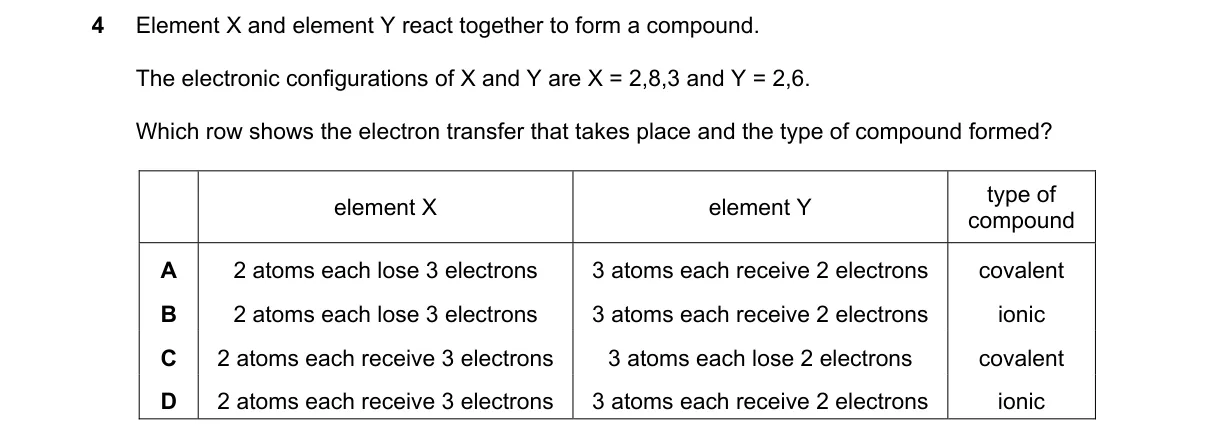
Answer choices
- A2 atoms each lose 3 electrons 3 atoms each receive 2 electrons covalent
- B2 atoms each lose 3 electrons 3 atoms each lose 2 electrons ionic
- C2 atoms each receive 3 electrons 3 atoms each lose 2 electrons covalent
- D2 atoms each receive 3 electrons 3 atoms each receive 2 electrons ionic
Explanation
Ionic bonding in Al₂O₃-like compound Steps:
- Identify valence electrons: X (2.8 likely simplifies to 2.8.3 for Al, valence 3) loses 3 e⁻; Y (2.6 for O, valence 6) gains 2 e⁻ to octet.
- Calculate electrons transferred: 2 X atoms lose 3 e⁻ each (6 e⁻ total); 3 Y atoms gain 2 e⁻ each (6 e⁻ total) for charge balance.
- Determine formula: Ratio 2:3 yields neutral ionic compound like Al₂O₃.
- Classify bonding: Metal (X) to nonmetal (Y) electron transfer forms ionic bonds.
Why B is correct:
- Matches ionic definition: Complete e⁻ transfer from electropositive X (loses 3 e⁻/atom) to electronegative Y (gains 2 e⁻/atom) in 2:3 ratio for stability.
Why the others are wrong:
- A: Covalent misclassifies; true transfer is ionic, not shared electrons.
- C: Reverses donor/acceptor roles; X loses, Y gains, not vice versa; covalent wrong.
- D: Both receiving electrons impossible; no donor, violates charge balance; ionic incorrect.
Final answer: B
Topic: Ion and ionic bonds
Practice more O Levels/IGCSE Chemistry (5070) questions on mMCQ.me