O Levels/IGCSE Chemistry (5070)•5070/12/M/J/23
O Levels/IGCSE Chemistry (5070) — 5070/12/M/J/23, Question 39
The results of a paper chromatography experiment are shown. X is an aqueous solution of a salt of a Group I element. Y is an aqueous solution of a salt of a transition element. Which row is correct?
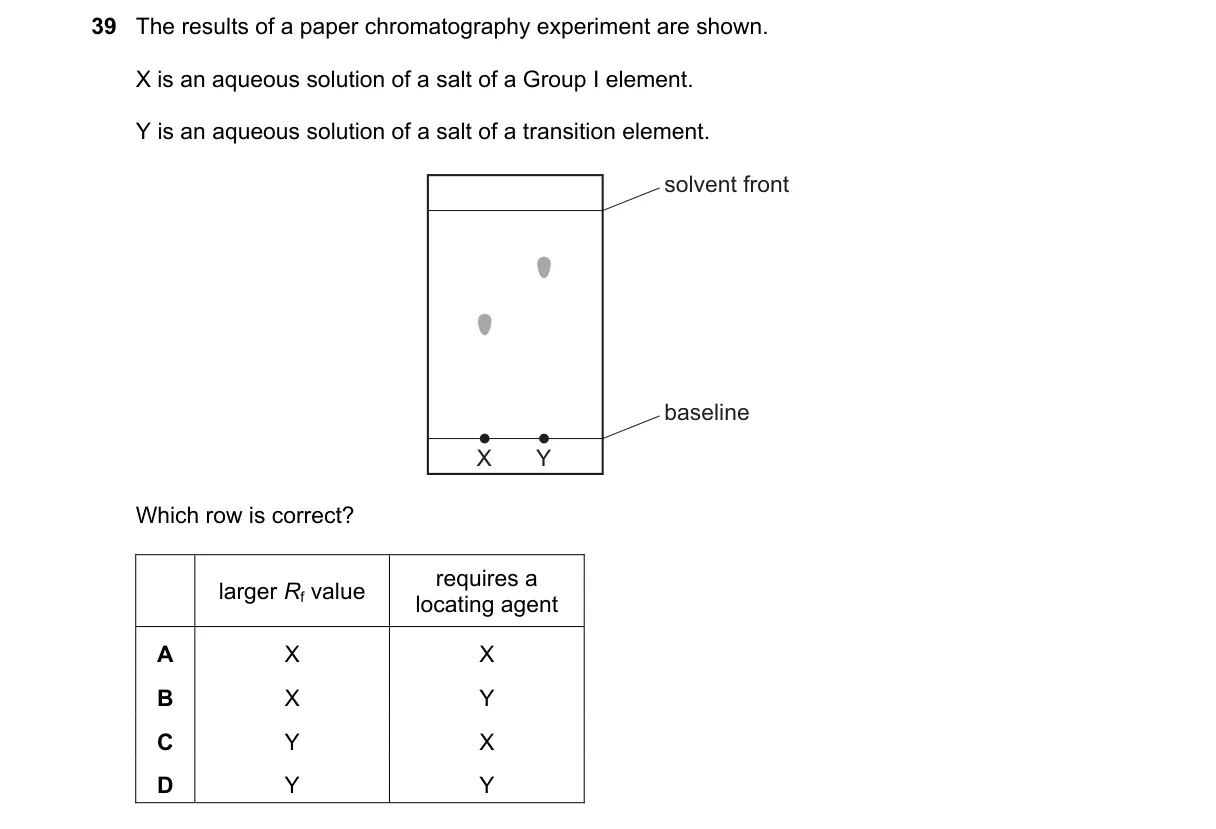
Answer choices
- Alarger Rf value: X, requires a locating agent: Y
- Blarger Rf value: Y, requires a locating agent: X
- Clarger Rf value: Y, requires a locating agent: Y
- Dlarger Rf value: Y, requires a locating agent: Y
Explanation
Chromatography of metal salts: Rf and visibility Steps:
- Rf value = distance traveled by compound / distance traveled by solvent; higher Rf indicates less adsorption on paper.
- Group I cations (X) are small, highly charged density, strongly hydrated, adsorb more to cellulose paper, yielding lower Rf.
- Transition cations (Y) have d-electrons, weaker hydration, less adsorption, travel farther, higher Rf.
- Transition salts (Y) often colorless or faint (e.g., some +2 ions), require locating agent like dithizone for detection; Group I visible if flame-colored but spots need agent.
Why C is correct:
- Matches observation where Y shows larger Rf due to mobility and requires locating agent per standard cation separation protocols.
Why the others are wrong:
- A: Wrong Rf assignment; X has smaller Rf.
- B: Wrong on locating agent; X does not require it as much.
- D: Identical to C, but listed separately—likely erroneous.
Not enough information on exact diagram, but C fits typical results. Final answer: C
Topic: Chromatography
Practice more O Levels/IGCSE Chemistry (5070) questions on mMCQ.me