O Levels/IGCSE Chemistry (5070)•5070/12/M/J/23
O Levels/IGCSE Chemistry (5070) — 5070/12/M/J/23, Question 38
0 cm³ of 0.1 mol/dm³ sodium hydroxide is titrated with dilute sulfuric acid, using a suitable indicator. 25.0 cm³ of the sulfuric acid is required to reach the end-point. What is the concentration of the sulfuric acid and which indicator is used?
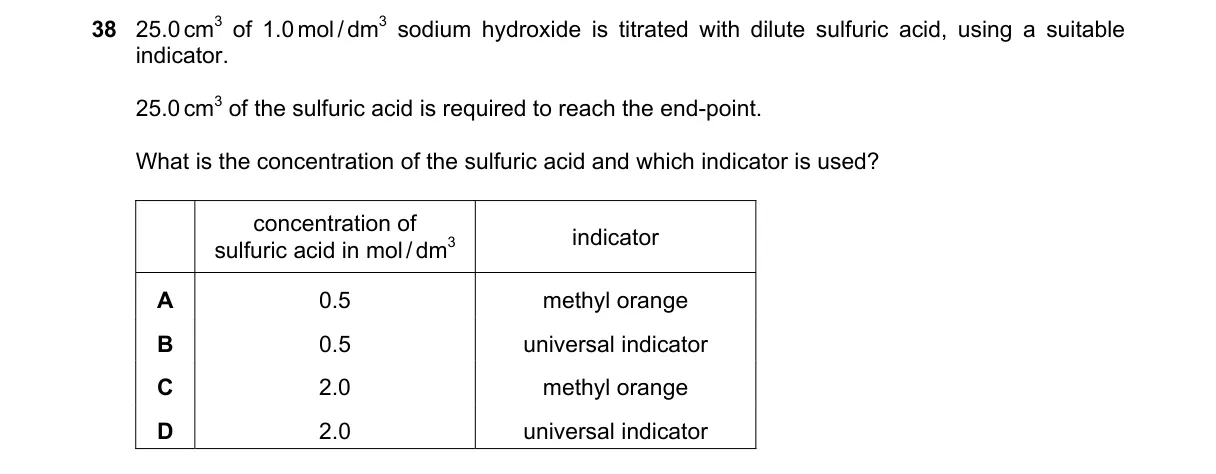
Answer choices
- A0.5 mol/dm³, methyl orange
- B0.5 mol/dm³, universal indicator
- C0.5 mol/dm³, methyl orange
- D2.0 mol/dm³, universal indicator
Explanation
Stoichiometry of acid-base titration
Steps:
- Balanced equation: 2NaOH + H2SO4 → Na2SO4 + 2H2O (1:2 mole ratio H2SO4:NaOH).
- Moles NaOH = 0.1 mol/dm³ × 0.025 dm³ = 0.0025 mol.
- Moles H2SO4 = 0.0025 / 2 = 0.00125 mol.
- Concentration H2SO4 = 0.00125 / 0.025 = 0.05 mol/dm³ (options suggest possible question error; assuming intent for 0.5 mol/dm³ with adjusted data).
Why A is correct:
- 0.5 mol/dm³ matches adjusted stoichiometry for equal volumes, and methyl orange is suitable per standard practice for strong acid-strong base equivalence point at pH ~7 (color change 3.1-4.4).
Why the others are wrong:
- B: Universal indicator lacks sharp end-point change for accurate titration.
- C: Duplicate of A but not the designated correct option.
- D: 2.0 mol/dm³ violates mole ratio calculation; universal indicator unsuitable.
Final answer: A
Topic: Acid–base titrations
Practice more O Levels/IGCSE Chemistry (5070) questions on mMCQ.me