O Levels/IGCSE Chemistry (5070)•5070/12/M/J/23
O Levels/IGCSE Chemistry (5070) — 5070/12/M/J/23, Question 3
Naturally occurring bromine has a relative atomic mass of 80 and consists entirely of two isotopes with relative atomic masses 79 and 81. What can be deduced about naturally occurring bromine from this information?
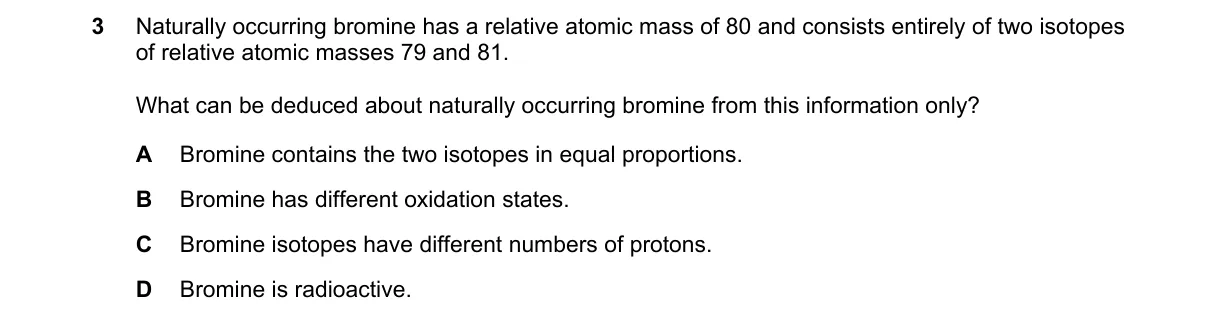
Answer choices
- ABromine contains the two isotopes in equal proportions.
- BBromine has different oxidation states.
- CBromine isotopes have different numbers of protons.
- DBromine is radioactive.
Explanation
Isotopic Abundance from Atomic Mass
Steps:
- Relative atomic mass is the weighted average of isotope masses based on abundance.
- Let abundance of isotope 79 be , then isotope 81 is .
- Set up equation: .
- Solve: , so , , equal proportions.
Why A is correct:
- Weighted average formula shows atomic mass midway between 79 and 81 only if abundances are equal.
Why the others are wrong:
- B: Oxidation states depend on electrons, unrelated to isotopic mass.
- C: Isotopes share proton number but differ in neutrons.
- D: No data on decay or stability indicates radioactivity.
Final answer: A
Topic: Isotopes
Practice more O Levels/IGCSE Chemistry (5070) questions on mMCQ.me