O Levels/IGCSE Chemistry (5070) — 5070/12/M/J/23, Question 27
Answer choices
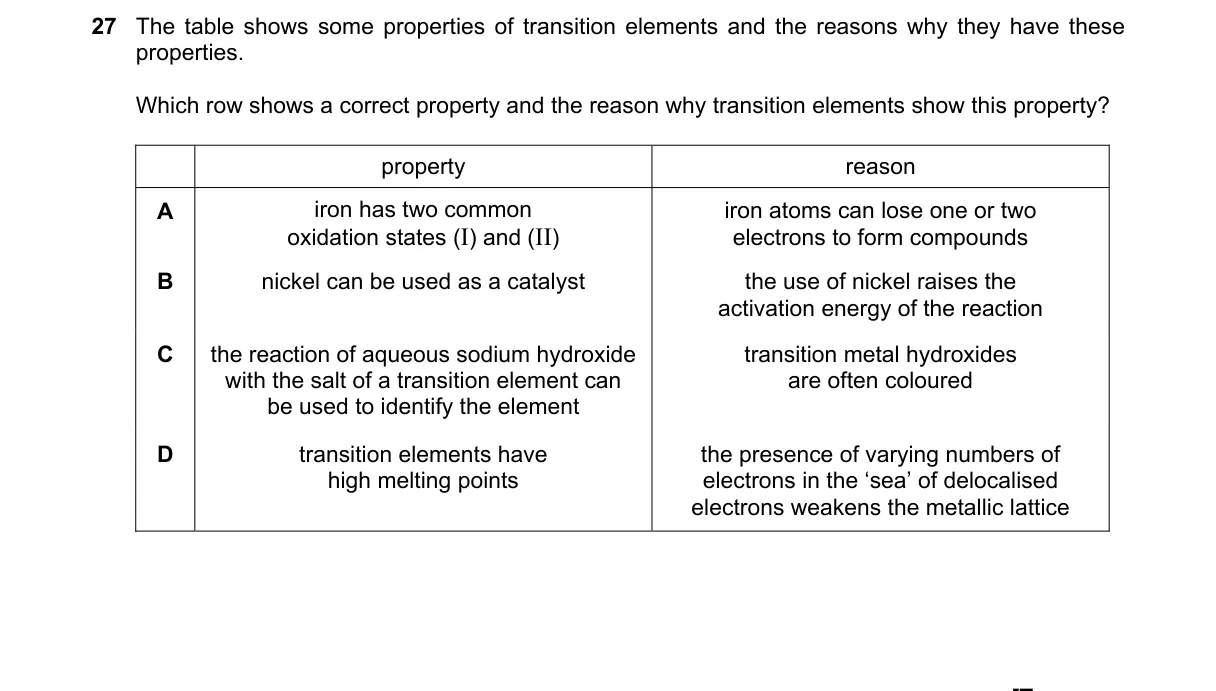
- AProperty: oxidation states (I) and (II) Reason: iron atoms can lose one or two electrons to form compounds
- BProperty: nickel can be used as a catalyst Reason: the use of nickel raises the activation energy of the reaction
- CProperty: the salt of transition element can be used to identify the element Reason: transition metals hydroxides are often coloured
- DProperty: transition elements have high melting points Reason: the presence of delocalised electrons weakens the metallic lattice
Explanation
Correct property and reason for transition elements Steps: - Evaluate option A: Iron's oxidation states (I) and (II) are due to d-orbital electrons, but the reason given is too general and not specific to transition metals. - Evaluate option B: Nickel catalyzes reactions by lowering activation energy, not raising it, so the reason is incorrect. - Evaluate option C: Transition metal salts form colored hydroxides due to d-d electron transitions, allowing identification, matching the reason. - Evaluate option D: High melting points result from strong metallic bonds with delocalized d-electrons, but the reason incorrectly states weakening. Why C is correct: - Transition metal hydroxides are colored because of d-d transitions in partially filled d-orbitals, per crystal field theory, enabling visual identification of the element. Why the others are wrong: - A: Reason is vague; transition elements show variable oxidation states due to small energy differences in d-electrons, not just losing one or two. - B: Catalysts lower activation energy to speed reactions, opposite of the stated reason. - D: Delocalized d-electrons strengthen, not weaken, the metallic lattice for high melting …
Practice more O Levels/IGCSE Chemistry (5070) questions on mMCQ.me