O Levels/IGCSE Chemistry (5070)•5070/12/M/J/23
O Levels/IGCSE Chemistry (5070) — 5070/12/M/J/23, Question 23
The addition of calcium hydroxide to soil reduces its acidity but also reduces the efficiency of fertilizers. Which equations explain this?
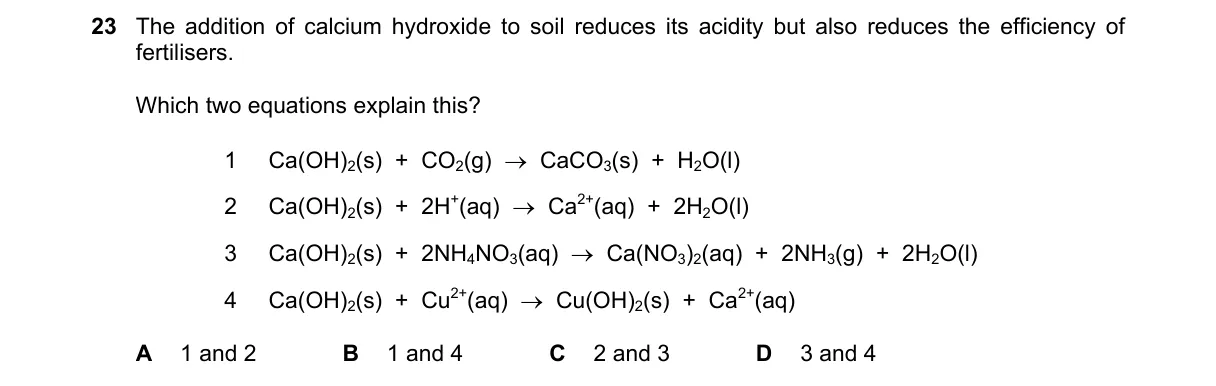
Answer choices
- A1 and 2
- B1 and 4
- C2 and 3
- D3 and 4
Explanation
Lime's Dual Effect on Soil pH and Fertilizer Availability
Steps:
- Calcium hydroxide (Ca(OH)₂) dissociates to release OH⁻ ions, neutralizing H⁺ in acidic soil via Ca(OH)₂ + 2H⁺ → Ca²⁺ + 2H₂O (equation 2).
- This raises soil pH, reducing acidity as intended.
- At higher pH, ammonium fertilizers (NH₄⁺) convert to volatile NH₃ gas via 2NH₄⁺ + Ca(OH)₂ → Ca²⁺ + 2NH₃↑ + 2H₂O (equation 3), causing nitrogen loss.
- Equations 2 and 3 together explain both the acidity reduction and fertilizer inefficiency.
Why C is correct:
- Option C pairs equation 2 (pH neutralization) with equation 3 (ammonia volatilization from fertilizers), directly linking lime's benefits and drawbacks per acid-base chemistry principles.
Why the others are wrong:
- A includes irrelevant equations not tied to pH or nutrient loss.
- B mixes neutralization with unrelated phosphate precipitation, missing nitrogen loss.
- D focuses only on precipitation reactions, ignoring acidity reduction.
Final answer: C
Topic: Fertilisers
Practice more O Levels/IGCSE Chemistry (5070) questions on mMCQ.me