O Levels/IGCSE Chemistry (5070)•5070/12/M/J/23
O Levels/IGCSE Chemistry (5070) — 5070/12/M/J/23, Question 19
Fe(II) reacts with chlorine. Fe²⁺(aq) + Cl₂(g) → Fe³⁺(aq) + 2Cl⁻(aq) Which statement about this reaction is correct?
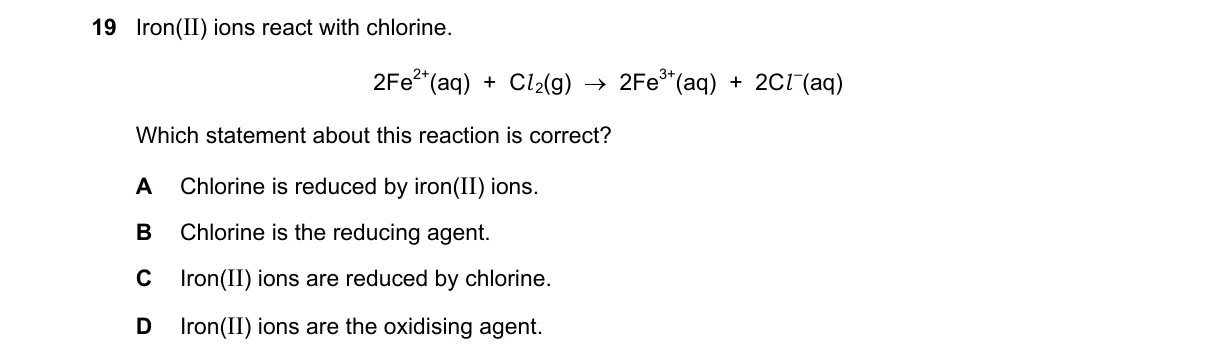
Answer choices
- AChlorine is reduced by iron(II).
- BChlorine is the reducing agent.
- CIron(II) ions are oxidized by chlorine.
- DIron(II) ions are the oxidizing agent.
Explanation
Redox Processes in the Reaction
Steps:
- Oxidation state of Fe changes from +2 in Fe²⁺ to +3 in Fe³⁺, indicating oxidation (loss of electron).
- Oxidation state of Cl changes from 0 in Cl₂ to -1 in 2Cl⁻, indicating reduction (gain of electrons).
- Fe²⁺ loses an electron to Cl₂, so Fe²⁺ is the reducing agent and Cl₂ is the oxidizing agent.
- Chlorine undergoes reduction caused by iron(II) ions.
Why A is correct:
- Reduction defined as gain of electrons; Cl₂ accepts an electron from Fe²⁺, reduced by the iron(II) reducing agent.
Why the others are wrong:
- B: Reducing agent is oxidized (loses electrons); Cl₂ is reduced, so it's the oxidizing agent.
- C: Fe²⁺ is oxidized, but the statement reverses roles—Cl₂ oxidizes Fe²⁺, not vice versa.
- D: Oxidizing agent is reduced (gains electrons); Fe²⁺ is oxidized, so it's the reducing agent.
Final answer: A
Topic: Redox
Practice more O Levels/IGCSE Chemistry (5070) questions on mMCQ.me