O Levels/IGCSE Chemistry (5070)•5070/12/M/J/23
O Levels/IGCSE Chemistry (5070) — 5070/12/M/J/23, Question 16
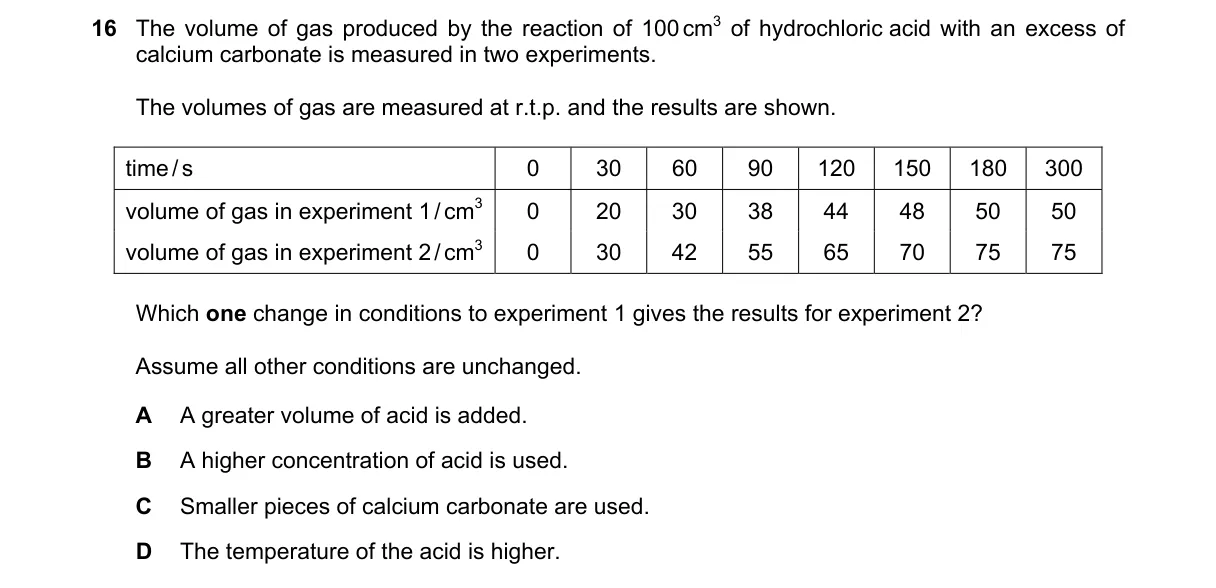
The volume of gas produced by the reaction of 100 cm³ hydrochloric acid with an excess of calcium carbonate is measured in two experiments. The volumes of gas are measured at r.t.p. and the results are shown. time/s gas in experiment 1/ cm³ 0 20 30 40 50 60 volume of gas in experiment 2/ cm³ 0 30 42 55 65 75 Assume one change in conditions is unchanged. Which one change in conditions gives the results for experiment 2?
Answer choices
- AA greater volume of acid is added.
- BA higher concentration of acid is used.
- CSmaller pieces of calcium carbonate are used.
- DThe temperature of the acid is higher.
Explanation
Higher acid concentration speeds up the reaction and increases total gas yield Steps:
- Compare data: Experiment 2 shows faster initial gas production (30 cm³ vs. 20 cm³ at 20 s) and higher volume at 60 s (75 cm³ vs. 60 cm³), with rate slowing to match experiment 1 later.
- Reaction rate depends on [HCl] and CaCO₃ surface area; total CO₂ volume equals moles of acid (excess CaCO₃).
- Faster rate and higher volume at fixed time indicate increased [HCl], raising both rate and total yield.
- Other changes either match rate (A) or increase rate without raising total yield (C, D).
Why B is correct:
- Higher [HCl] increases collision frequency (collision theory), accelerating rate; same 100 cm³ volume means more moles, yielding more CO₂.
Why the others are wrong:
- A: Same [HCl] keeps initial rate unchanged, though total yield rises; data shows faster rate.
- C: Greater surface area speeds rate but total yield unchanged (same acid moles).
- D: Higher temperature boosts rate (Arrhenius equation) but total yield unchanged.
Final answer: B
Topic: Rate of reaction
Practice more O Levels/IGCSE Chemistry (5070) questions on mMCQ.me