O Levels/IGCSE Chemistry (5070)•5070/12/M/J/23
O Levels/IGCSE Chemistry (5070) — 5070/12/M/J/23, Question 12
Aqueous copper(II) sulfate is electrolysed using copper electrodes. The current is constant and the anode is weighed at regular time intervals. Which graph is obtained when the mass of the anode is plotted against time?
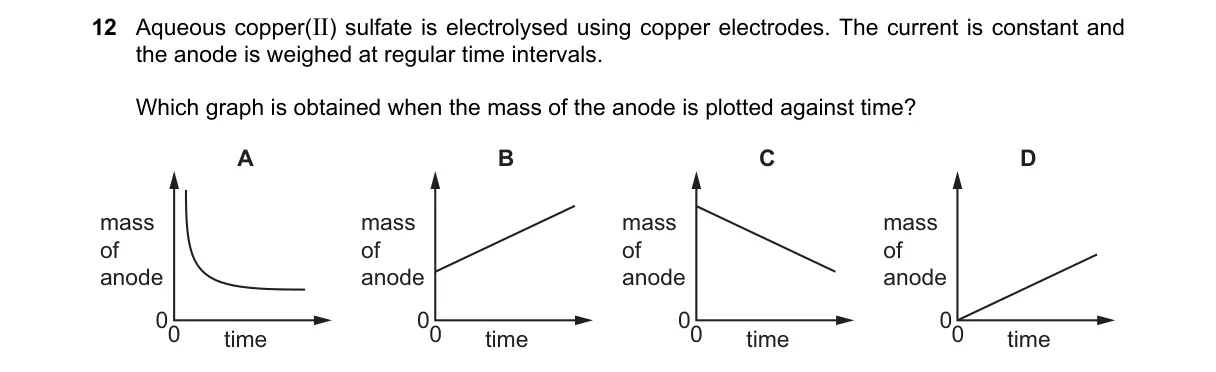
Answer choices
- AOption A
- BOption B
- COption C
- DOption D
Explanation
Anode mass decreases linearly due to constant dissolution rate
Steps:
- Anode reaction: Cu(s) → Cu²⁺(aq) + 2e⁻, dissolving copper and reducing anode mass.
- Cathode reaction: Cu²⁺(aq) + 2e⁻ → Cu(s), depositing copper but irrelevant for anode weighing.
- Constant current means constant electron flow, so constant rate of Cu atoms lost from anode.
- Plot of anode mass vs. time is linear decrease, as mass loss ∝ current × time (Faraday's first law).
Why C is correct:
- C shows straight-line decrease, matching constant mass loss rate from Faraday's laws of electrolysis.
Why the others are wrong:
- A: Shows increase, but anode dissolves, so mass decreases.
- B: Shows curved decrease, but constant current yields linear, not accelerating, loss.
- D: Shows no change or irregular, but steady electrolysis causes consistent mass reduction.
Final answer: C
Topic: Electrolysis
Practice more O Levels/IGCSE Chemistry (5070) questions on mMCQ.me