O Levels/IGCSE Chemistry (5070)•5070/11/M/J/23
O Levels/IGCSE Chemistry (5070) — 5070/11/M/J/23, Question 40
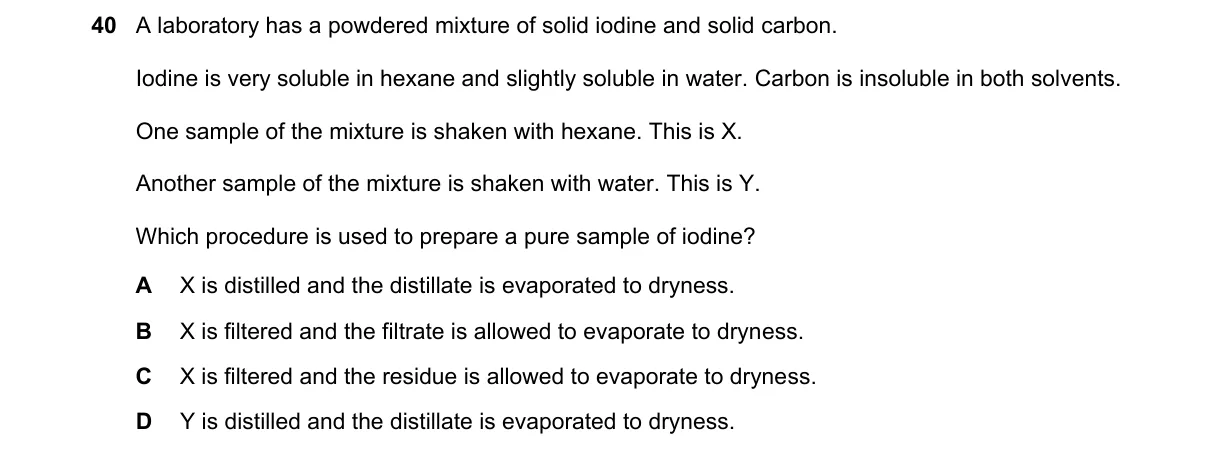
A laboratory has a powdered mixture of solid iodine and solid carbon. Iodine is very soluble in hexane and slightly soluble in water. Carbon is insoluble in both solvents. One sample of the mixture is shaken with hexane. This is X. Another sample of the mixture is shaken with water. This is Y.
Answer choices
- AX is distilled and the distillate is evaporated to dryness.
- BX is filtered and the filtrate is allowed to evaporate to dryness.
- CX is filtered and the residue is allowed to evaporate to dryness.
- DY is distilled and the distillate is evaporated to dryness.
Explanation
Solvent Extraction of Iodine with Hexane
Steps:
- Shake mixture with hexane (X): Iodine dissolves in hexane; carbon remains insoluble.
- Filter X: Filtrate contains dissolved iodine in hexane; residue is solid carbon.
- Evaporate filtrate to dryness: Hexane solvent removes, leaving pure solid iodine.
- This isolates iodine from the mixture.
Why B is correct:
- Iodine's high solubility in hexane allows it to dissolve selectively, enabling separation via filtration and evaporation of the iodine-containing filtrate (solubility-based extraction principle).
Why the others are wrong:
- A: Distillation of X yields hexane distillate; evaporating it recovers only solvent, not iodine.
- C: Residue after filtering X is insoluble carbon; evaporation yields no change or separation.
- D: Y (water-shaken) has minimal iodine dissolved; distilling yields water distillate, evaporating it gives no solid.
Final answer: B
Topic: Separation and purification
Practice more O Levels/IGCSE Chemistry (5070) questions on mMCQ.me