O Levels/IGCSE Chemistry (5070)•5070/11/M/J/23
O Levels/IGCSE Chemistry (5070) — 5070/11/M/J/23, Question 38
An organic compound, P, is dissolved in water. The concentration of the solution is 0.1 mol/dm³ and a solid is added to the solution and effervescence is seen. Which equation could represent this reaction?
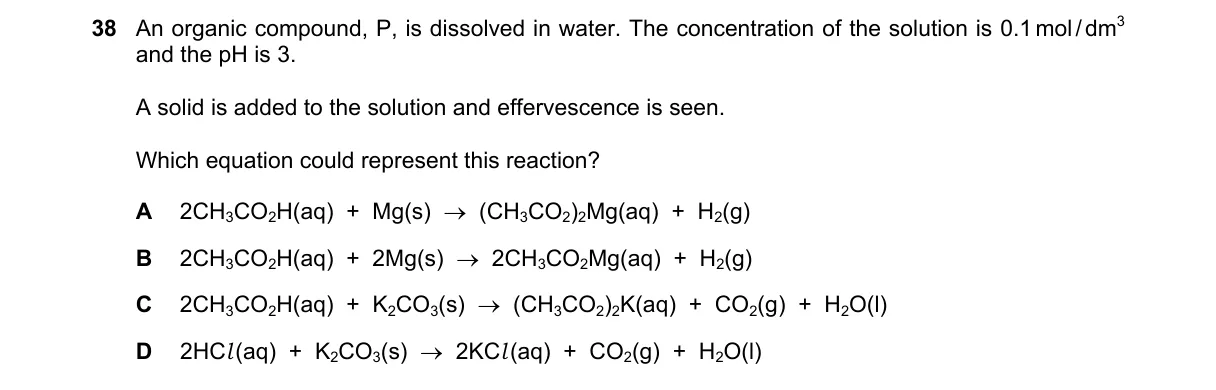
Answer choices
- A2CH₃COOH(aq) + Mg(s) → (CH₃COO)₂Mg(aq) + H₂(g)
- B2CH₃COOH(aq) + Mg(s) → CH₃COOMg(aq) + H₂(g)
- C2CH₃COOH(aq) + K₂CO₃(s) → (CH₃COO)₂K(aq) + CO₂(g) + H₂O(l)
- D2CH₃COOH(aq) + K₂CO₃(s) → 2CH₃COOK(aq) + CO₂(g) + H₂O(l)
Explanation
Acid-metal reaction producing hydrogen gas effervescence
Steps:
- Effervescence signals gas release; with dilute organic acid solution, adding reactive metal like Mg produces H₂.
- Organic compound P is CH₃COOH(aq) at 0.1 mol/dm³, a weak acid that reacts with metals.
- Solid added is Mg(s), displacing hydrogen from the acid.
- Verify balance: Option A correctly shows 2CH₃COOH + Mg → (CH₃COO)₂Mg + H₂.
Why A is correct:
- Equation balances atoms (C:4, H:8, O:4, Mg:1) and uses correct formula for divalent Mg salt (CH₃COO)₂Mg per ionic compound rules.
Why the others are wrong:
- B: Incorrect salt formula CH₃COOMg (should be (CH₃COO)₂Mg); unbalanced carbon and hydrogen atoms.
- C: Wrong salt formula (CH₃COO)₂K (potassium acetate is CH₃COOK); unbalanced potassium (2 left, 1 right).
- D: K₂CO₃(s) is highly soluble in water, unlike the insoluble metal solid implied for sustained effervescence.
Final answer: A
Topic: The characteristic properties of acids and bases
Practice more O Levels/IGCSE Chemistry (5070) questions on mMCQ.me