O Levels/IGCSE Chemistry (5070)•5070/11/M/J/23
O Levels/IGCSE Chemistry (5070) — 5070/11/M/J/23, Question 16
Universal indicator contains several dyes. The reversible reaction of one, HIn, is shown. HIn(aq) ⇌ H+(aq) + In-(aq) A few drops of universal indicator solution are added to 50 cm³ of water. Which row describes what happens when acid is added to the solution.
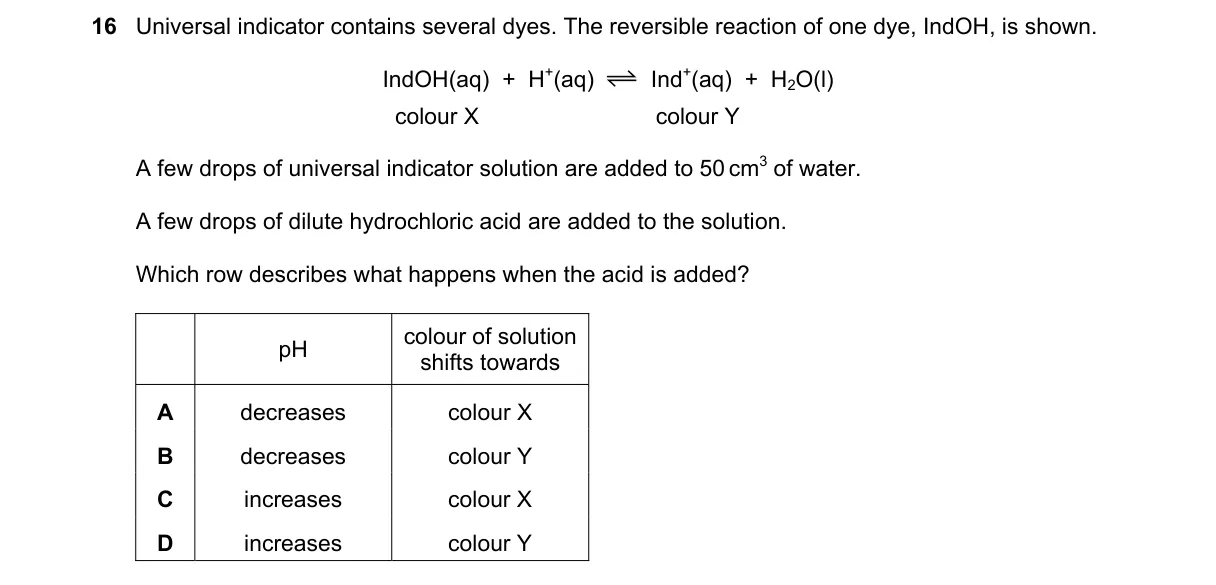
Answer choices
- ApH decreases, colour of solution colour X
- BpH decreases, colour of solution colour Y
- CpH increases, colour of solution colour X
- DpH increases, colour of solution colour Y
Explanation
Acid addition shifts indicator equilibrium to acidic form
Steps:
- Pure water has pH 7; universal indicator shows neutral color (assume X).
- Adding acid increases [H⁺(aq)], decreasing pH below 7.
- Equilibrium HIn(aq) ⇌ H⁺(aq) + In⁻(aq) shifts left (Le Châtelier's principle), increasing HIn.
- HIn form gives acidic color Y.
Why B is correct:
- Acid addition raises [H⁺], lowering pH and producing acidic color Y via HIn dominance.
Why the others are wrong:
- A: Color X is neutral/basic, not acidic.
- C: Acid decreases pH, does not increase it.
- D: Acid decreases pH and gives color Y, not X.
Final answer: B
Topic: The characteristic properties of acids and bases
Practice more O Levels/IGCSE Chemistry (5070) questions on mMCQ.me