O Levels/IGCSE Chemistry (5070)•5070/11/M/J/23
O Levels/IGCSE Chemistry (5070) — 5070/11/M/J/23, Question 11
Concentrated aqueous sodium chloride is electrolysed using inert electrodes. Which row shows what happens in this electrolysis and why it happens?
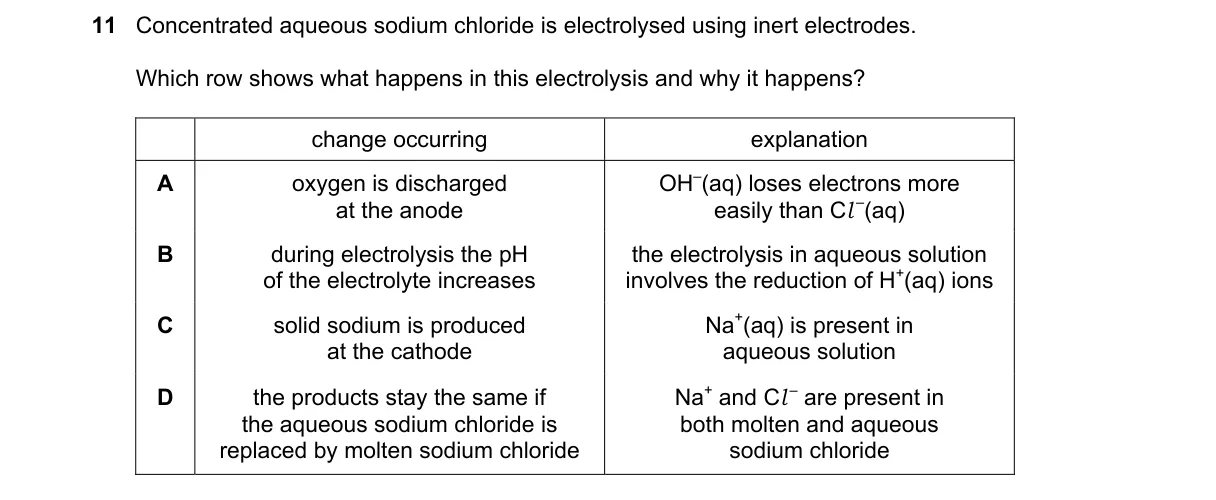
Answer choices
- Aduring electrolysis the pH OH(aq) loses electrons more
- Bof the electrolyte increases easily than Cl-(aq)
- Csolid sodium is produced involves Na+(aq) reduction to H2(g)
- Dat the cathode the same if Na+(aq) is present the products stay the same Na+ and Cl- are present if replaced by molten sodium chloride in both molten and aqueous sodium chloride
Explanation
Electrolysis of concentrated aqueous NaCl prioritizes water reduction at cathode over Na+.
Steps:
- Identify ions present: Na+(aq), Cl-(aq), H2O (which provides H+(aq)/OH-(aq)).
- At cathode (reduction): H2O reduces to H2(g) + OH-(aq) because its potential (-0.83 V) is less negative than Na+ (-2.71 V).
- At anode (oxidation): Cl-(aq) oxidizes to Cl2(g) due to high concentration overcoming OH- preference (overpotential for O2 evolution).
- Overall: H2 and Cl2 produced; OH- accumulation raises pH.
Why B is correct:
- pH increases as OH-(aq) forms at cathode via 2H2O + 2e- → H2 + 2OH-, per standard electrode potentials.
Why the others are wrong:
- A: pH rise is from cathode OH-, not anode where Cl- oxidizes preferentially over OH-.
- C: No solid Na produced; cathode reduces water to H2, not Na+.
- D: Products differ—aqueous gives H2/OH- and Cl2; molten gives Na and Cl2.
Final answer: B
Topic: Electrolysis
Practice more O Levels/IGCSE Chemistry (5070) questions on mMCQ.me