O Levels/IGCSE Chemistry (5070)•5070/12/M/J/22
O Levels/IGCSE Chemistry (5070) — 5070/12/M/J/22, Question 3
Some reactions of an aqueous solution of compound X are given. • When a few drops of aqueous sodium hydroxide are added, a white precipitate is formed. • When dilute nitric acid is added and the mixture is warmed, a gas is formed. The gas decolourises acidified potassium manganate(VII). • When dilute nitric acid and aqueous barium nitrate are added, no visible reaction occurs. What can be deduced about the identity of X?
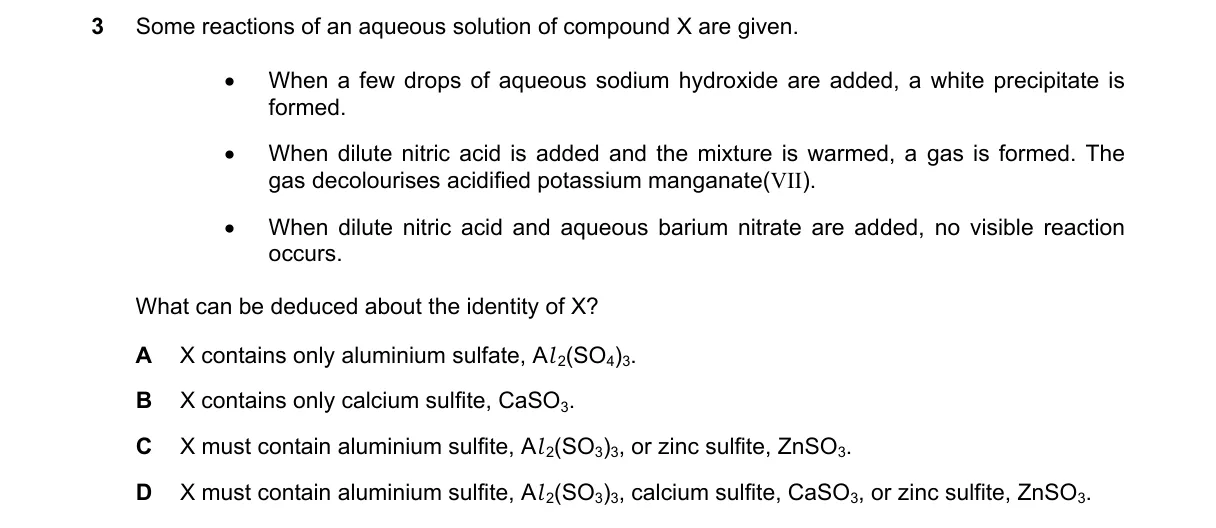
Answer choices
- AX contains only aluminium sulfate, Al2(SO4)3.
- BX contains only calcium sulfate, CaSO4.
- CX must contain aluminium sulfate, Al2(SO4)3, or zinc sulfate, ZnSO4.
- DX must contain aluminium, Al3+, calcium sulfate, CaSO4, or zinc, Zn2+.
Explanation
X is a metal sulfite forming a white hydroxide precipitate Steps:
- White precipitate with dilute NaOH indicates a cation like Al³⁺, Zn²⁺, or Ca²⁺ that forms an insoluble hydroxide.
- Gas evolving on warming with dilute HNO₃ that decolourises acidified KMnO₄ is SO₂, confirming SO₃²⁻ anion from a sulfite salt.
- No visible reaction (no precipitate) when adding dilute HNO₃ and Ba(NO₃)₂ shows absence of SO₄²⁻, as BaSO₄ would form in acid; SO₃²⁻ decomposes to SO₂ instead.
- Combining tests, X is Al₂(SO₃)₃, ZnSO₃, or CaSO₃.
Why D is correct:
- D lists the cations (Al³⁺, Zn²⁺) and Ca component fitting the hydroxide and sulfite tests, per qualitative analysis for insoluble metal hydroxides and SO₃²⁻ behavior.
Why the others are wrong:
- A: Al₂(SO₄)₃ contains SO₄²⁻, forming BaSO₄ precipitate in acid.
- B: CaSO₄ contains SO₄²⁻, forming BaSO₄; no SO₂ gas produced.
- C: Both Al₂(SO₄)₃ and ZnSO₄ contain SO₄²⁻, forming BaSO₄ precipitate.
Final answer: D
Topic: Identification of ions and gases
Practice more O Levels/IGCSE Chemistry (5070) questions on mMCQ.me